
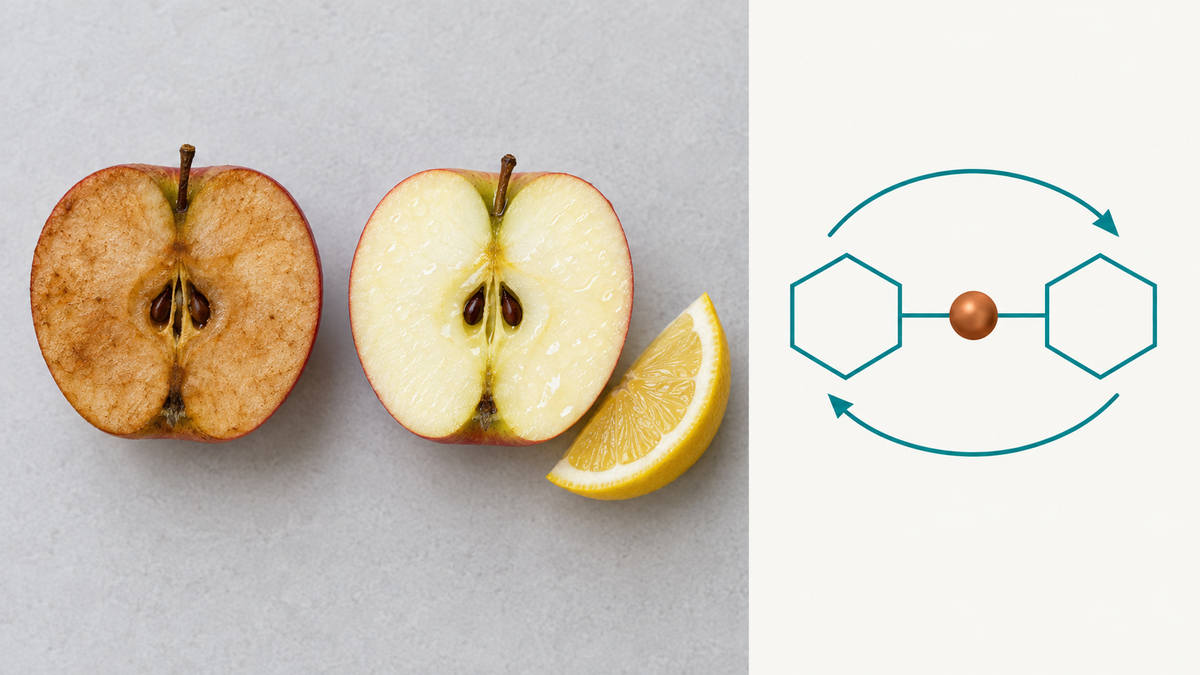
Cut an apple in half, leave one face bare and brush the other with lemon juice, and within twenty minutes the difference is obvious. The usual explanation is that the acid slows the enzyme down. That explanation is not wrong, but it is roughly half of what is happening, and the missing half is the more interesting one.
Most kitchen accounts stop at the acid because acid is the part that is easy to describe. The assumption is that lemon juice works the way vinegar or any other sour liquid would work. It does not, quite. Lemon juice carries two separate anti-browning agents that act by two unrelated chemical routes, and the second route is why lemon juice outperforms a plain acid of the same strength.
The enzyme, and why cutting starts the clock
The reaction has a name and a catalyst. Polyphenol oxidase is a copper-containing enzyme in the oxidoreductase family, catalogued as EC1.10.3.1 in its diphenol-oxidase form and EC1.14.18.1 as monophenol monooxygenase (Recent Trends in Controlling the Enzymatic Browning of Fruit and Vegetable Products, PMC).
Its catalytically active region is built around a binuclear copper centre holding two copper ions, designated CuA and CuB, where CuA is involved in the enzyme’s solubility in water and CuB binds the substrate. A small number of plants carry a trinuclear version with a third copper site that serves as the linkage point for molecular oxygen (Recent Advances of Polyphenol Oxidases in Plants, PMC).
In an intact apple, the enzyme and its phenolic substrates are kept in separate compartments. Slicing, bruising, or the tissue breakdown that comes with age ruptures those compartments and lets enzyme, substrate and atmospheric oxygen meet in one place (Institute of Food Science and Technology). Cutting into the cells releases polyphenol oxidase, which then reacts with the oxygen in the air (ScienceLine, University of California, Santa Barbara).
The catalysis runs in two steps. A monophenol is hydroxylated to an o-diphenol, then the o-diphenol is oxidised to an o-quinone (Recent Advances of Polyphenol Oxidases in Plants, PMC). The o-quinone is where the enzyme’s work ends and the colour problem begins: quinones and their derivatives polymerise through several further reactions into melanin, a relatively insoluble brown pigment (Recent Trends in Controlling the Enzymatic Browning of Fruit and Vegetable Products, PMC).
The colour, then, is not the enzyme’s own product. The enzyme manufactures a colourless, highly reactive intermediate, and the brown arrives when that intermediate reacts onward with itself and with the amino acids and proteins around it. Anything that removes the intermediate before it condenses stops the visible outcome without ever touching the enzyme.
That two-stage structure matters for everything that follows. There is an enzymatic stage, which can be inhibited, and a downstream chemical stage, which can be reversed while it is still early.
Route one: dropping the pH out from under the enzyme
Enzymes have a pH range in which they function well, and polyphenol oxidase is no exception. Its optimal activity sits at pH 5 to 7; it is described elsewhere in the same review as active at pH 6 to 7 and inactive below pH 3, with inhibition setting in below pH 3.0 (Recent Trends in Controlling the Enzymatic Browning of Fruit and Vegetable Products, PMC). A broader survey of plant polyphenol oxidases puts the optimum across species at pH 5.0 to 8.0 and notes that both acidic and alkaline conditions decrease catalytic activity (Recent Advances of Polyphenol Oxidases in Plants, PMC).
Lemon juice sits at about pH 2 (ScienceLine, University of California, Santa Barbara). Brushing it onto a cut surface does not change the pH of the whole fruit; it changes the pH in the thin layer where the enzyme was just released, which is the only layer that matters. The enzyme is still present and still intact — it has simply been moved to a pH where it works poorly.
Citric acid, the dominant acid in lemon juice, does one additional thing beyond lowering pH. It is a copper-chelating agent, and it can suppress polyphenol oxidase activity by binding the metal cofactors in the enzyme’s structure. In lettuce-head material it has been characterised as a noncompetitive inhibitor at 2.7 mM (same review). Given that the active site is a copper centre, an agent that ties up copper is attacking the catalytic machinery directly rather than just changing the conditions around it. That is the quietly clever thing about citric acid: it is both the acid and the chelator.
Route two: undoing the reaction after it has happened
The second agent is ascorbic acid, and its mechanism is entirely different. It does not interact with the enzyme at all. It works through its reducing activity, on the products instead of the catalyst.
Specifically, ascorbic acid reduces the o-quinones formed by the enzyme back to their precursor diphenols (same review). The enzyme keeps turning diphenols into quinones; the ascorbic acid keeps turning quinones back into diphenols. Nothing accumulates, so nothing polymerises, so no melanin forms. The reaction is running the whole time and going nowhere.
This is also why the protection has a shelf life. Ascorbic acid is itself oxidised in the process, to dehydroascorbic acid, and once it is fully oxidised the o-quinones can no longer be reduced back to diphenols — at which point browning resumes through melanin generation (same review). The reducing agent is consumed. It is a finite supply of undo, not a permanent barrier. The dose is what buys the duration, and the enzyme underneath is what spends it.
So lemon juice delays browning. It does not prevent it indefinitely, and any account promising otherwise is describing a mechanism that does not exist. The honest version is that a lemon-juiced apple face browns later and more slowly than a bare one, and the margin depends on how much ascorbic acid went on and how fast the enzyme is working underneath.
None of this makes the acid redundant, either. The two routes compound: the pH drop and the copper chelation slow the rate at which quinones are produced, which means the finite pool of ascorbic acid is drawn down more slowly. Acidifying agents are commonly combined with antioxidants, chelating agents and enzyme inhibitors precisely because the combinations outperform single treatments (same review). In sugarcane juice, browning was efficiently inhibited below pH 4.1 when treated with ascorbic or citric acid (same review). Lemon juice happens to deliver both classes in one squeeze, which is not a designed advantage but is a real one.
What the browning actually costs
Worth stating plainly, because the internet is unclear on it: for the fruits under discussion here — apples, pears, bananas, avocado, potatoes — enzymatic browning is a quality change, not a safety problem. A browned apple slice is not spoiled and not hazardous. It looks worse and reads as older.
The literature frames it the same way. Enzymatic browning is characterised as generally unfavourable after harvest because of deteriorated appearance and decreased nutrition, and as something that seriously reduces commercial value, with no food-safety hazard classification attached (same survey of plant polyphenol oxidases). The same review notes browning accounted for about 50 percent of the loss of fruits and vegetables during processing, and the Institute of Food Science and Technology likewise attributes substantial food waste to it (Institute of Food Science and Technology).
Reputation and performance diverge here in a useful way. The reaction is not the enemy in every context — the same enzymatic chemistry improves the flavour and colour of tea, coffee and cocoa (same survey of plant polyphenol oxidases). Browning is only a defect when the appearance of freshness is the product. In a cup of black tea it is the entire point of the process, run deliberately and to completion.
The other levers, briefly
Acid and ascorbate are the kitchen-scale tools, but they are not the only ones. Physical controls include temperature management, controlled atmosphere, high pressure and ultrasound; high temperatures can rapidly deactivate polyphenol oxidase, at the cost of appearance, texture and nutritional value (same survey of plant polyphenol oxidases).
That trade-off explains the domestic hierarchy. Blanching genuinely stops the enzyme, and it also cooks the fruit, which disqualifies it for a cheese board. Submerging slices in water limits oxygen access without altering the flesh. Refrigeration slows the enzyme along with everything else. Lemon juice is the option that intervenes chemically while leaving the fruit raw, which is why it persists in kitchens despite being the least permanent of the lot.
For the same enzyme-meets-oxygen logic in a different fruit, the chemistry behind why cutting onions makes you cry follows an equivalent compartment-rupture pattern with a different set of products. And for what else is in that squeeze of juice, the health benefits of lemons covers the ascorbic acid from the nutritional side rather than the reactive one.
Takeaway
The actual mechanism is two mechanisms. Citric acid drops the surface pH away from polyphenol oxidase’s optimum of roughly 5 to 7 and chelates the copper at its active site, slowing quinone production. Ascorbic acid reduces the o-quinones that do form back to diphenols, so they never polymerise into melanin — until the ascorbic acid is itself oxidised and runs out.
Practical consequences: apply it to the cut surface rather than the whole fruit, apply it soon after cutting rather than after colour appears, expect a delay measured in hours rather than days, and reapply if the slices need to hold. Lab notes for your kitchen, with one honest caveat attached — this buys time, and the amount of time is finite by design.
Kitchen Chemistry — September 25, 2026
Leave a Reply