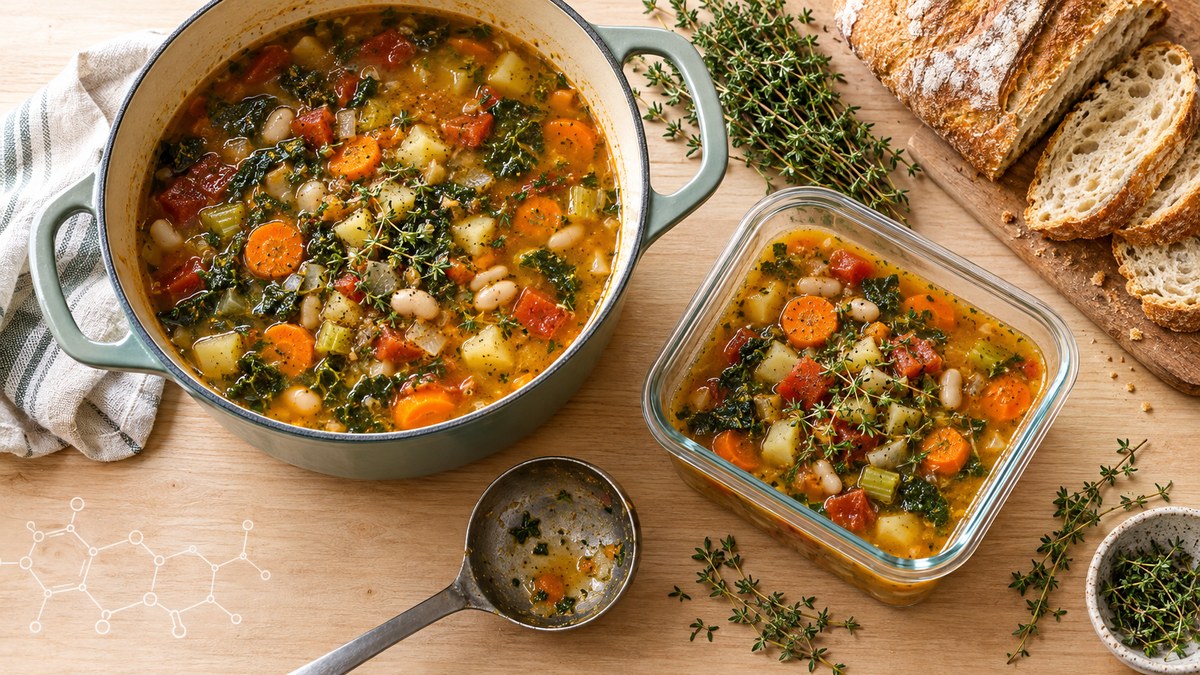
Soup doesn’t get better overnight because the fridge cooks it. Almost every explanation you’ll hear says the flavors “meld,” which is true, but it’s also vague enough to explain anything. The more useful question is what’s actually moving, what’s actually changing, and what isn’t changing at all once the heat is off.
So why does soup taste better the next day? The actual answer has three parts: dissolved flavor compounds slowly even out through the pot, starch and gelatin change the texture in ways your mouth reads as richness, and your own nose resets after a night away from the kitchen. There’s also a fourth part that matters more than any of them: how you cool the soup decides whether the second bowl is safe.
What stops when the heat stops
Start with what doesn’t happen in the refrigerator. Many of the reactions that make soup taste good in the first place need heat. Paul Adams, senior science research editor at America’s Test Kitchen, lists Maillard browning, the conversion of collagen to gelatin and the dissolving of pectin from plant cell walls as changes that happen only under heat, during direct cooking (America’s Test Kitchen).
That rules out the idea that soup keeps “developing” new browned flavors overnight. At 40°F, the Maillard reaction is effectively stopped. Whatever richness the browning built, it built on the stove. What changes overnight is how those finished flavors are distributed, and how the soup’s structure holds them.
There is a short tail, though. A pot of stew stays hot for a while after it leaves the burner, and BBC Science Focus notes that collagen continues to break down for roughly half an hour after the heat is turned off, since the conversion happens between about 71°C and 96°C (BBC Science Focus). After that, the chemistry slows to a crawl.
Diffusion: flavor evens out through the pot
The biggest real change is diffusion. Dissolved flavor compounds move from where they’re concentrated to where they’re not, even in a cold pot. Adams describes salty, umami and tangy elements moving in and out of the solid ingredients, balancing and integrating the overall flavor (America’s Test Kitchen).
Think about what a freshly finished soup looks like at a microscopic level. The broth is salty and savory. The center of a chunk of carrot or a cube of potato is not, because it spent most of the cooking time releasing its own sugars and water rather than absorbing broth. A bean simmered for an hour has taken in some of the liquid around it, but letting it sit for hours in that broth “does a much more complete job,” in Adams’s phrasing.
Diffusion is slow, especially when cold, which is why it needs hours rather than minutes. It’s driven by concentration differences, so it keeps working until the pieces and the broth come closer to equilibrium. The quietly clever thing about this process is that it doesn’t add flavor. It redistributes flavor that was already there. The broth tastes a little less sharp, the vegetables taste a little more seasoned, and the whole bowl tastes like one dish instead of several ingredients sharing a pot.
Starch: the sponge that carries flavor inward
Starchy ingredients add a second mechanism. Potatoes, beans, lentils, peas, rice and pasta are full of starch granules that swelled and gelatinized as they cooked. As the soup cools and rests, that starch keeps soaking up free water, and the water carries dissolved flavor with it. BBC Science Focus offers pea and ham soup as the example: it tastes better the next day because the pea starch has absorbed the ham stock (BBC Science Focus).
Cooling also changes the starch itself. As gelatinized starch chills, some of its molecules, especially amylose, begin to realign into more ordered structures, a process called retrogradation. That’s why a potato soup or a bean soup is noticeably thicker on day 2, and why it can seem to have “set” in the container. When you reheat it, some of that structure loosens again, but the soup often stays thicker and coats the spoon more than it did the night before.
Thicker body matters for flavor, not only texture. A soup that clings to the tongue a little longer gives your taste receptors and nose more time with it. Many cooks read that as a deeper flavor, even if the flavor molecules themselves haven’t changed.
Gelatin: the silky texture after reheating
Soups and stews made with bones, skin or tough cuts of meat get a third boost from gelatin. During long cooking, collagen in the connective tissue unravels into gelatin and dissolves into the broth. In the refrigerator, that gelatin sets into a soft jelly, and when you reheat it, the gelatin melts back into the liquid and gives the soup a silky feel in the mouth (BBC Science Focus).
You can see this happen in a container of chicken soup made from a whole bird: on day 2, the broth wobbles when you tip it. That’s not fat. It’s protein structure, and it’s a sign the broth will have more body when it’s hot again. Cold also lets fat rise and harden on the surface, which is a handy bonus: you can lift off as much or as little of it as you like before reheating.
Your nose resets overnight
The last piece of the answer has nothing to do with the soup. It’s about the cook.
After hours of chopping, simmering, stirring and tasting, your senses adapt. Adams points out that our senses very quickly build up a tolerance to smells and tastes with prolonged exposure, so a cook who has spent all afternoon with a pot can find it good but not exciting, while the same soup a day later offers much more contrast and novelty (America’s Test Kitchen). Volatile aroma compounds that filled the kitchen for hours stop registering as strongly. A night’s sleep clears that adaptation.
This is also why the “better tomorrow” effect is hard to measure. BBC Science Focus notes that when chef and writer J. Kenji López-Alt compared fresh and day-old dishes side by side, he found little difference (BBC Science Focus). None of this makes the effect imaginary. It suggests that for some soups, especially thin brothy ones, much of the improvement is perception, while starchy and gelatin-rich soups have real physical changes behind them.
Which soups improve, and which don’t
Based on those mechanisms, you can predict which soups are worth making a day ahead.
Likely to improve: bean, lentil and split pea soups; potato and chowder-style soups; chili and stews with tough cuts of meat; tomato-based soups; and any soup with lots of whole spices or dried chiles. These have starch, gelatin or chunky ingredients that benefit from diffusion.
Likely to decline: soups with pasta or rice cooked in them, which keep absorbing broth until they turn soft and the soup turns thick; soups finished with delicate herbs like basil or cilantro, which lose their fresh aroma; and seafood soups, where shrimp and fish can turn tough on reheating. For these, store the components separately and combine them when you reheat.
The part that matters most: cooling it safely
None of the flavor benefits are worth it if the soup isn’t cooled properly. A large pot of soup is one of the slowest foods in the kitchen to cool, and that’s a real food-safety problem.
The FDA describes the temperature danger zone, where pathogens grow most readily, as roughly 41°F to 135°F, and the FDA Food Code sets a 2-step cooling standard for cooked foods: from 135°F to 70°F within 2 hours, then from 70°F to 41°F or below within the next 4 hours (FDA). That standard is written for food businesses, but the logic applies at home.
The reason is spores. Bacteria such as Clostridium perfringens, which is associated with gravies, thick soups and cooked beans, and Bacillus cereus can form spores that survive cooking (Hong Kong Centre for Food Safety). If the soup lingers in the danger zone, those spores can germinate and the bacteria can multiply quickly. The same guidance warns that B. cereus can also produce toxins in the food itself, and reheating alone can’t make a contaminated sauce safe. Germany’s Federal Institute for Risk Assessment gives the same advice in different words: cool cooked food quickly, splitting larger amounts into several shallow bowls (BfR).
Lab notes for your kitchen: how to cool, store and reheat soup
Divide it into shallow containers. USDA guidance is to put food into shallow containers and refrigerate it immediately for rapid cooling (USDA). A full stockpot in the refrigerator can stay warm in the center for hours.
Don’t leave it out. Discard any soup left at room temperature for more than 2 hours, or 1 hour if the room is above 90°F (USDA).
Speed it up with an ice bath. Set the pot in a sink of ice water and stir for 10 to 15 minutes before portioning. The FDA lists ice-water baths and stirring among its recommended cooling methods (FDA).
Eat it within 3 to 4 days. USDA’s cold-storage chart gives soups and stews 3 to 4 days in the refrigerator at 40°F, or 2 to 3 months in the freezer for best quality (USDA).
Reheat to 165°F. USDA recommends reheating leftovers to 165°F (USDA). For soup, that means bringing it to a full simmer and stirring so the center heats evenly.
Adjust the seasoning after reheating. Starchy soups thicken overnight and may need a splash of water or broth. Taste once it’s hot, since cold food tastes less salty than warm food, and add fresh herbs or a squeeze of lemon at the end to restore the brightness that time softens.
The takeaway
Soup tastes better the next day for real reasons, just not magical ones. Overnight, dissolved flavors spread evenly between broth and solids, starch absorbs seasoned liquid and thickens the body, gelatin sets and then melts into a silkier texture, and your nose recovers from an afternoon of cooking. Nothing new is browned or created in the refrigerator. Cool the pot quickly in shallow containers, eat it within 3 to 4 days, and reheat it to a full simmer. Do that, and day 2 is usually the best bowl in the pot.
Hubert Bonizzone, October 16, 2026
Leave a Reply