
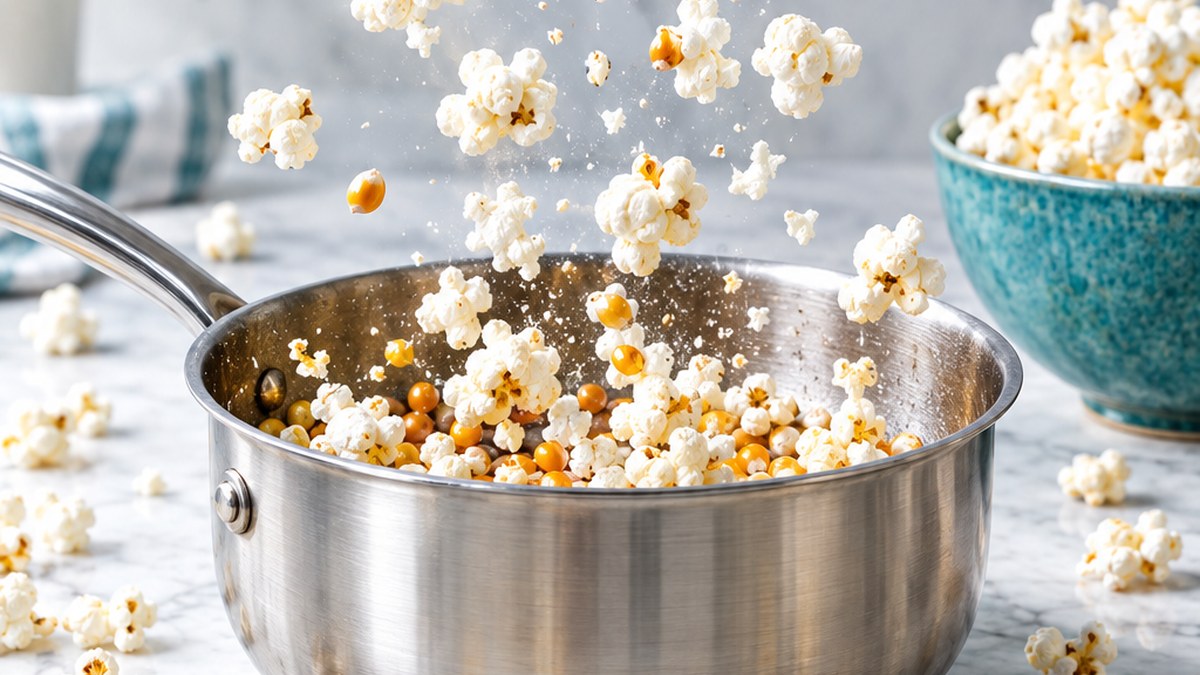
Popcorn isn’t corn that happens to explode. It’s a specific kind of corn built like a tiny pressure cooker, and almost every detail of that design matters. Most explanations stop at “the water inside turns to steam,” which is true, but it doesn’t explain why sweet corn from the grocery store won’t pop, why the sound happens when it does, or why a few kernels in every bag refuse to cooperate.
So why does popcorn pop? The actual answer involves three parts working together: a sealed, unusually strong hull, a precise amount of water, and a starchy interior that turns into foam at just the right moment. Here’s how each one works, with the numbers behind it.
The anatomy: a sealed pressure vessel
A popcorn kernel has three main parts. On the outside is the pericarp, the hard, glossy hull. Inside is the endosperm, mostly starch, plus a small amount of trapped water. And at the base is the germ, the part that would grow into a new plant.
The pericarp is the critical piece. In popcorn, it’s tough and nearly waterproof, so when the kernel heats up, the moisture inside can’t escape gradually the way it would from other corn types. It’s trapped, and pressure builds (Carolina Biological Supply).
Researchers at Purdue University showed that the hull’s strength comes down to its chemistry. They compared 14 varieties of yellow popcorn and found the share of unpopped kernels ranged from 4% in the best variety to 47% in the worst. The difference traced to the pericarp: in the best-popping varieties, the cellulose molecules in the hull were arranged in a stronger, more ordered crystalline structure, which held moisture in more effectively (Phys.org, on Purdue research, 2005).
The water: a narrow target
Water is the fuel. Too little and there isn’t enough steam to burst the hull. Too much and the hull can rupture early or the flake comes out tough.
Cereal chemists have measured this window carefully. Several studies place the moisture content that maximizes expansion at about 12.5% to 14.0% (Cereal Chemistry, 1992). That’s a remarkably narrow range for something that sits in a pantry, which is why storage matters so much, a point we’ll come back to.
The heat: what happens on the way to 180°C
As a kernel heats, the trapped water passes 100°C (212°F) and starts turning to steam. Because the steam can’t escape, pressure inside rises sharply.
In 2015, French physicists Emmanuel Virot and Alexandre Ponomarenko filmed kernels on a hot plate at high speed to find the tipping point. At 170°C, 34% of kernels had popped. At 180°C (356°F), 96% had burst, regardless of the size or shape of the kernel. At that temperature, pressure inside reached roughly 10 times atmospheric pressure at sea level (BBC News, on Virot & Ponomarenko, 2015).
Older cereal-chemistry work arrived at a closely matching figure from a different direction: popping at about 177°C, equivalent to an internal pressure of about 931 kPa, or 135 psi (Cereal Chemistry, 1992). The quietly elegant overlap here is that two research groups, decades apart and using completely different methods, landed within a few degrees of each other.
The burst: starch turns into foam
When the hull finally fails, the pressure drops instantly. The superheated water inside flashes into steam all at once, and the starch around it, already softened and gelatinized by the heat and moisture, expands with it. As the steam escapes, the starch stretches into a network of thin walls and air pockets, then cools and sets in that shape almost immediately.
That’s the white, fluffy flake. It’s essentially a starch foam, frozen in place. The kernel expands to roughly 20 to 50 times its original size (Wikipedia, Popcorn kernel).
The French team captured something else in their footage. As the hull splits, a limb-shaped starchy structure they called a “leg” pushes out first. It presses against the hot surface and launches the kernel into the air, anywhere from a few millimeters to a few centimeters (BBC News, 2015). The researchers described the process as happening in some hundredths of a second (Virot & Ponomarenko, Journal of the Royal Society Interface, 2015). The jumping you see in a pan isn’t steam rocketing the kernel. It’s the kernel kicking off the bottom.
The sound: not the crack you’d expect
The obvious guess is that the “pop” is the hull cracking. The high-speed recordings say otherwise.
The sound happens too early to be caused by the jump. Virot and Ponomarenko concluded the pop is most likely caused by the sudden release of water vapor. Once the hull bursts, the drop in pressure turns the cavities inside the kernel into small acoustic resonators, a little like blowing across the top of a bottle (BBC News, 2015).
Two shapes, one mechanism
If you look closely at a bowl of popcorn, you’ll notice the flakes aren’t all the same. Popcorn sold in stores generally comes in two shapes: “butterfly” flakes, with irregular wings sticking out in several directions, and “mushroom” flakes, which are rounder and denser.
The difference comes from how the starch foam expands once the hull gives way. In butterfly types, the foam pushes out unevenly through several weak points in the ruptured hull, producing those thin, crisp wings. In mushroom types, the expansion is more uniform, so the flake balls up into a compact sphere.
The practical consequence is about texture and durability. Butterfly flakes have more surface area and more fragile edges, which makes them light, tender and good at catching melted butter and salt, but they break easily. Mushroom flakes are sturdier, so they hold up to being stirred through hot caramel or chocolate without shattering. It’s the same reaction, the same steam, the same 180°C threshold. Only the geometry of the escape changes.
Microwave, stovetop or air popper: same physics, different heat
Every popping method is just a different way of getting water inside the kernel to that tipping point quickly.
On a stovetop, heat moves from the pan into the oil and from the oil into the kernel’s surface, then inward. In a hot-air popper, a stream of heated air does the same job without oil, which is why air-popped flakes are lighter and drier. A microwave works differently: it heats the water molecules inside the kernel directly, so the kernel warms from within rather than from the outside in.
The goal in all three cases is the same. Heat fast enough that steam can’t slip out through small flaws in the hull before the pressure builds, and get the popped flakes away from the heat before they scorch. Slow, uneven heat is the enemy in every method.
Why most corn won’t pop
This is where the design matters. Sweet corn, dent corn and flint corn all contain starch and water, but most varieties lack popcorn’s combination of a thick, strong, nearly airtight pericarp and a dense endosperm. Their hulls let steam leak out slowly, so pressure never builds to the bursting point. You end up with a scorched kernel, not a flake.
Humans worked this out a very long time ago. Corn remains found at Paredones and Huaca Prieta, on Peru’s northern coast, date from 6,700 to 3,000 years ago, and the cob characteristics show people there were eating popcorn and flour corn (Smithsonian). That pushes popcorn back 2,000 years earlier than previously reported, and before pottery was used in the region.
In practice: fewer duds, better flakes
Every part of the mechanism points to something you can do in your own kitchen.
Store kernels airtight. Since popping depends on keeping moisture in that 12.5% to 14% window, kernels left in an open bowl or a loosely sealed bag slowly dry out. Dry kernels don’t build enough steam, and they become the hard, unpopped “old maids” at the bottom of the pan. A sealed jar in a cool cupboard keeps them in range. The Purdue team linked better popping to hulls that hold moisture in more effectively (Phys.org, 2005).
Heat evenly and quickly. A kernel that heats slowly can leak steam through tiny weak points before reaching 180°C. In a pan, a thin layer of oil spreads heat evenly across the kernel’s surface, and a single layer of kernels avoids cold spots.
Vent the steam once it’s popped. The escaping vapor that makes the pop doesn’t stop when the kernel bursts. Leaving a lid cracked or shaking the popcorn into a wide bowl lets that steam escape instead of condensing back onto the flakes and making them chewy.
Eat it fresh. Popped popcorn goes stale for the same reasons bread does: moisture migrates and starch structures change over time (more on that in our post on why bread goes stale). None of this makes day-old popcorn inedible. It just won’t have that crisp, shattering texture.
The takeaway
Popcorn pops because a strong, crystalline hull traps a carefully balanced amount of water, the water turns to high-pressure steam on the way to about 180°C, and when the hull finally gives way, the softened starch inside expands into a foam in a fraction of a second. The pop is escaping vapor. The jump is a starchy leg pushing off the pan.
That’s the whole formula: keep the water in, heat it fast, let the steam out. Store your kernels sealed, and you’ll see far fewer duds at the bottom of the bowl.
Hubert Bonizzone, October 9, 2026
Leave a Reply