
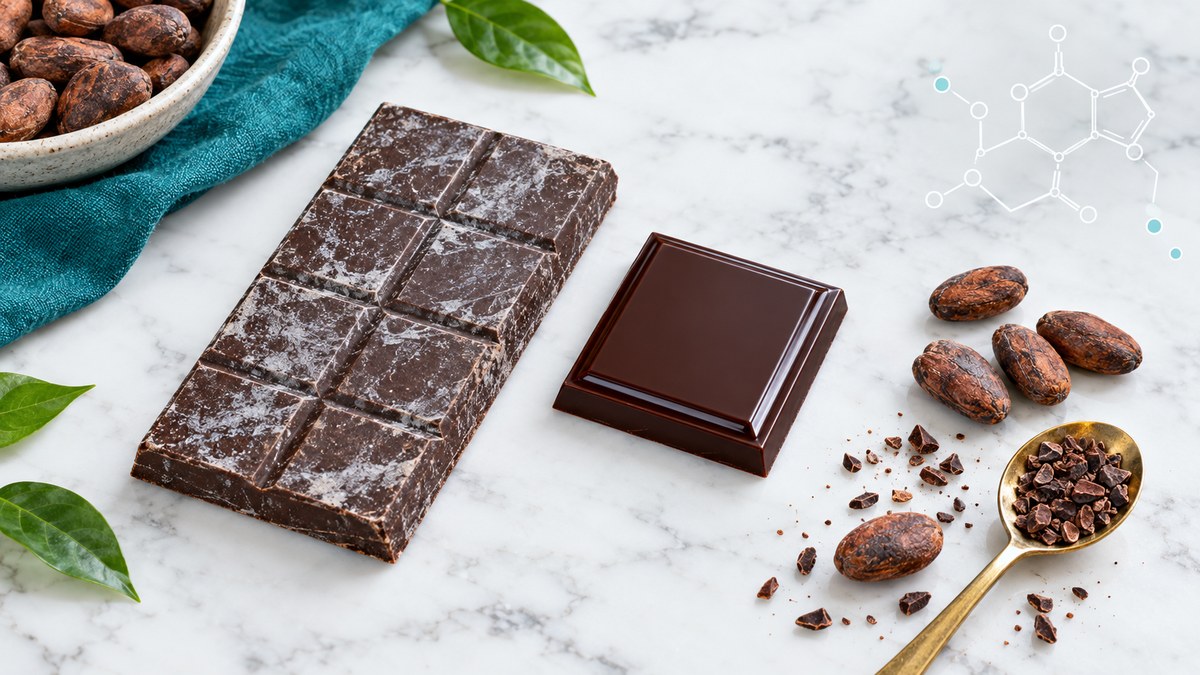
Chocolate that turns white isn’t moldy, and it usually isn’t even old. That chalky gray film on a forgotten bar, or the white streaks on a box of holiday chocolates, is called bloom. It’s the result of a crystal problem, and sometimes a water problem, happening right at the surface.
So why does chocolate turn white? The actual answer comes down to cocoa butter, one of the most finicky fats in the kitchen. It can set into six different crystal structures, and only one of them gives chocolate its gloss and snap. When that structure shifts, or when moisture pulls sugar to the surface, the light hitting the bar scatters instead of reflecting, and the chocolate looks white. Here’s how each version works.
Cocoa butter: one fat, six crystal forms
Most fats melt over a broad, forgiving range. Cocoa butter does something stranger: it’s polymorphic, meaning the same fat molecules can stack into several distinct crystal arrangements, each with its own melting point.
Researchers have identified six forms, numbered I through VI. In the classic measurements by Wille and Lutton, they melt at roughly 17.3°C, 23.3°C, 25.5°C, 27.5°C, 33.9°C and 36.3°C, from least stable to most stable (Ghazani & Marangoni, Nature Communications, 2021). The chocolate industry’s own tempering guides use the same ladder, listing Form V as “temper stable” and Form VI as “bloom” (Cargill tempering instructions).
Form V is the one everyone wants. It’s the structure behind a glossy surface, a clean snap and a melt that starts right around mouth temperature (Ewens, Metilli & Simone, Current Research in Food Science, 2021). The quietly clever thing about Form V is that its melting range sits just below body temperature. It holds firm on the shelf and gives way on the tongue.
Tempering: forcing the right crystal
If you melt chocolate and let it cool on its own, cocoa butter crystallizes in a mix of unstable forms. The result is soft, dull and streaky. Tempering is the process of heating, cooling and gently reheating chocolate so that Form V crystals get a head start and the unstable forms melt away.
It doesn’t take much. Chocolate is considered in temper when only 2% to 4% of its cocoa butter has crystallized in the stable form (Cargill). Those few starter crystals act as a template. As the rest of the fat sets, it copies the structure it touches, the same way a single ice crystal can organize a whole tray of supercooled water.
That’s why tempered chocolate behaves so differently from chocolate that was simply melted and re-set. The ingredients are identical. The crystal arrangement is not.
Fat bloom: when Form V slowly becomes Form VI
Form V is the best form for eating, but it isn’t the most stable form. Given time, warmth and temperature swings, cocoa butter drifts toward Form VI, which has larger crystals and a higher melting point.
Fat bloom is generally described as cocoa butter melting and recrystallizing as Form VI at the surface of the chocolate (Ewens et al., 2021). Those larger crystals scatter light, which is what turns a glossy surface gray or white (Rothkopf et al., Journal of Food Processing and Preservation, 2026).
Temperature cycling speeds the process. In one storage study, chocolate cycled between 20°C and 32°C moved from complete Form V at the start to complete Form VI after 60 days (Journal of Food Engineering, 2019). Each warm phase softens some of the fat and lets it move; each cool phase lets it recrystallize, and the kinetic advantage goes to the more stable form.
The same researchers note an honest caveat: the V-to-VI shift is consistently seen alongside bloom, but whether it directly causes bloom, or simply happens at the same time as fat movement, is still debated (Journal of Food Engineering). Both processes appear to reinforce each other (Rothkopf et al., 2026).
Why should a crystal form matter so much to how a surface looks? Gloss depends on how evenly light reflects. A tight network of small, uniform Form V crystals gives a smooth surface that bounces light back like a mirror. Larger, irregular Form VI crystals poking up through that surface break it into countless tiny facets, and each one sends light off in a different direction. Your eye reads that scattered light as white or gray, even though the chocolate underneath is exactly as dark as it was the day it was made. It’s the same reason crushed ice looks white while a clear ice cube doesn’t.
Why filled chocolates bloom faster
If you’ve noticed that pralines, hazelnut chocolates and chocolate-coated cookies bloom more readily than a plain bar, there’s a reason. In the industry, most fat bloom problems show up in filled products, and oil migration is considered the main cause (Delbaere et al., European Journal of Lipid Science and Technology, 2016).
Nut fillings contain softer, liquid oils. Over time those oils travel into the chocolate shell, dissolve some of its solid cocoa butter crystals, and the dissolved fat recrystallizes in an undesired form, which eventually shows up as visible bloom (Delbaere et al., 2016).
The effect can even vary nut by nut. A 2026 study of whole-hazelnut chocolates found that bloom sometimes appears on only part of a single bar, and traced the difference to individual hazelnuts (Rothkopf et al., 2026). One oilier nut can be enough to start bloom in the chocolate around it.
Sugar bloom: the water version
Not all bloom involves fat. Sugar bloom is a moisture problem, and it looks and feels different.
When chocolate meets humidity, or condensation forms on it after it comes out of a cold refrigerator, water on the surface dissolves some of the sugar. When that water evaporates, the sugar recrystallizes as a dry, white, dusty layer (Michigan State University Extension). Iowa State University’s food science team notes that sugar bloom is most likely in chocolate that has been refrigerated (Iowa State University Extension).
How to tell which bloom you have
There’s a simple kitchen test, and it works because the two blooms are made of different things.
Fat bloom tends to look streaky or swirled, white or gray, and it feels slick. Rub it gently with a warm fingertip and it melts, because it’s fat (MSU Extension).
Sugar bloom tends to look spotty or dusty and feels dry or slightly rough. It won’t melt under a fingertip, because sugar crystals need far more heat than your skin provides (MSU Extension; Iowa State).
You can also try a drop of water on a small spot. Sugar bloom dissolves; fat bloom beads up and stays put.
Is bloomed chocolate safe to eat?
Yes. Bloomed chocolate is still safe to eat; the change is in appearance and surface texture (MSU Extension). Iowa State’s guidance is even more direct: bloom affects neither the taste nor the shelf life of chocolate and doesn’t make it unsafe (Iowa State Extension).
Part of the reason is water activity, a measure of how much free water is available for microbes. Chocolate sits at roughly 0.3 to 0.4, which is low enough that microbial growth risk is very low (Iowa State Extension). That’s also why the date on a bar is usually a “best by” quality date, not a safety cutoff.
None of this makes bloomed chocolate as pleasant to eat out of hand. The texture can be a little waxy or chalky, and the snap is softer. But there’s no need to throw it out.
Can you fix it?
You can’t restore the surface of a bloomed bar, but you can reset the crystals by melting it (MSU Extension). Melting erases every crystal form, Form VI included, so bloomed chocolate works perfectly well in brownies, hot chocolate, ganache or anything that calls for melted chocolate.
If you want it glossy again, melt it and temper it. You’ll be building a fresh Form V network from scratch, which is exactly what a chocolate maker does.
Lab notes for your kitchen: storing chocolate so it doesn’t bloom
Keep it cool, not cold. Iowa State recommends roughly 65°F to 70°F with relative humidity below 50% to 55% (Iowa State Extension). MSU Extension notes that fat bloom becomes more likely once chocolate sits above about 70°F to 75°F, and above 88°F to 90°F it starts to melt (MSU Extension).
Avoid temperature swings. Steady temperature matters as much as the number itself. A pantry shelf beats a sunny counter or the top of the refrigerator, where heat from the appliance comes and goes.
Skip the refrigerator when you can. It’s humid inside, and condensation forms when cold chocolate meets warm air (MSU Extension). If you must refrigerate, wrap the chocolate airtight and let it come to room temperature before unwrapping, so moisture forms on the wrapper rather than the surface.
Wrap it well. An airtight container also keeps chocolate from absorbing nearby odors, since cocoa butter readily picks up aromas (Iowa State Extension).
Eat filled chocolates sooner. Because oil migration drives bloom in pralines and nut chocolates, they have a shorter window of peak appearance than plain bars.
The takeaway
Chocolate turns white for one of two reasons: its cocoa butter has slowly reorganized into a larger, light-scattering crystal form, or moisture has dissolved surface sugar that then dried into a dusty film. Neither is mold, and neither makes chocolate unsafe. Keep chocolate cool, dry and at a steady temperature, and melt any bloomed pieces into something warm. The crystals start over, and so does the chocolate.
Hubert Bonizzone, October 13, 2026
Leave a Reply