by Hubert Bonizzone
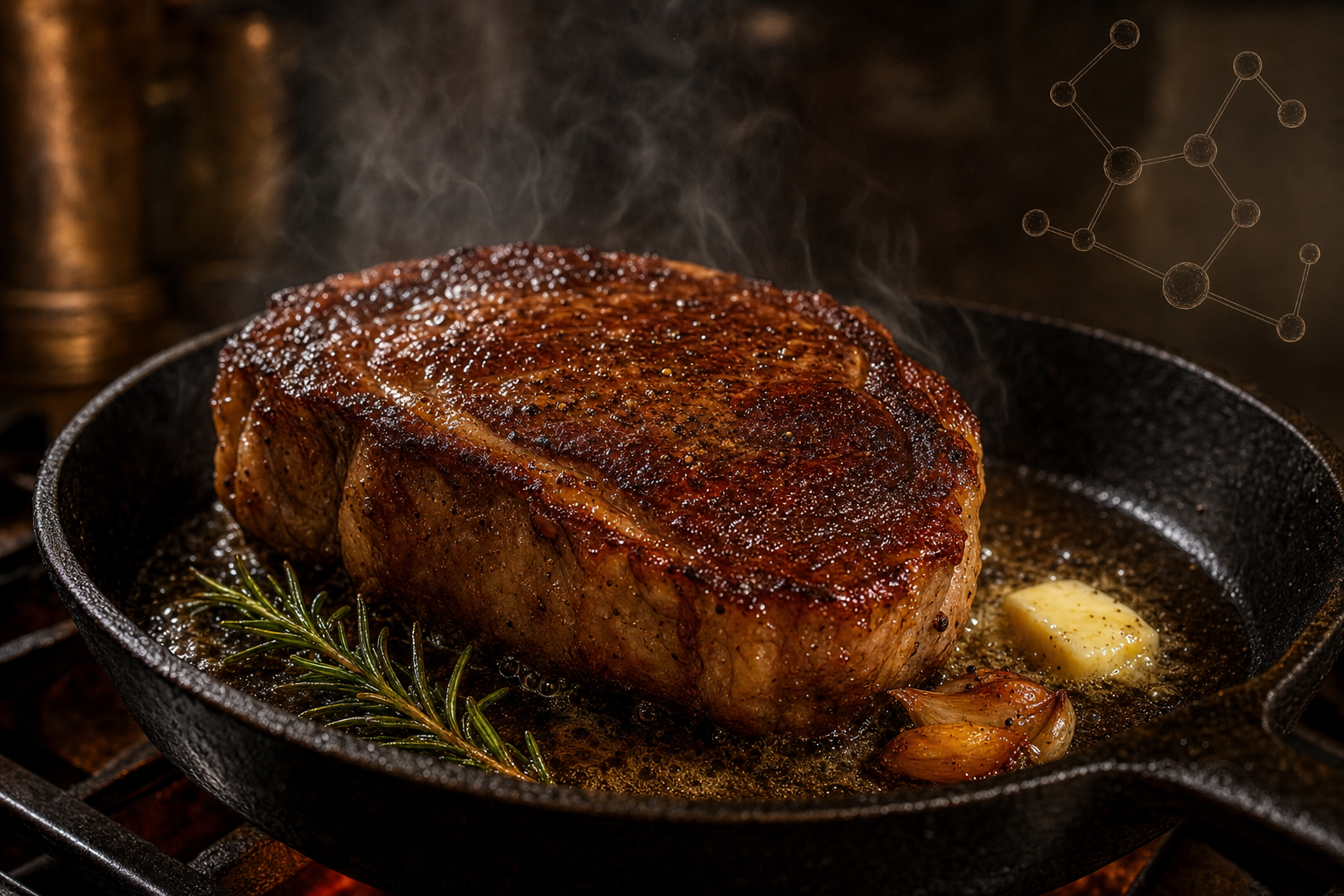
A steak’s crust isn’t “sealed in juice,” and it isn’t caramelized sugar — it’s the visible result of a specific chemical reaction between amino acids and sugars, one that only fires under a narrow, controllable set of conditions. Understanding what’s actually happening on that hot surface turns a handful of half-remembered kitchen rules (“pat it dry,” “get the pan smoking hot,” “don’t crowd the pan”) into a coherent set of decisions you can make on purpose, for any cut, in any pan you own.
What’s Actually Happening: The Chemistry of Browning
The Maillard reaction is the reaction between a nitrogen-containing compound — free amino acids on the surface of the meat — and a reducing sugar, like glucose, present in the muscle tissue’s residual glycogen (American Chemical Society, C&EN). Heat drives the sugar and amino acid to combine into an unstable intermediate, which rearranges through a chain of steps into hundreds of new small-molecule compounds — the aromas, flavors, and brown pigments your nose and eyes register as “seared” (American Chemical Society, C&EN). A related pathway, Strecker degradation, breaks down specific amino acids like leucine and valine into the aldehydes and pyrazines responsible for much of a sear’s toasty, roasted, almost nutty character — the same class of compounds researchers formally track when analyzing meat’s volatile aroma profile (Formation and Analysis of Volatile and Odor Compounds in Meat, Foods, 2022).
This reaction has a temperature floor. It starts slowly around 110°C (230°F) and accelerates sharply above 140°C (284°F), with its rate roughly doubling for every additional 10°C — which is exactly why a bare-minimum hot pan gets you a pale, gray-brown crust while a properly ripping one gets you deep mahogany color in under two minutes (ADA Cooking, Thermal Mass and Searing). A controlled study comparing seared steak to oven-cooked steak found the meat surface needs to exceed roughly 150°C to form a proper crust, and directly measured the chemistry behind it: reducing sugar content on the seared steak’s surface dropped to 1.71 mM versus 2.53 mM on the oven-cooked steak — meaning the sugar was consumed by the reaction — while browning absorbance nearly doubled, and blind taste panels rated the seared steak’s overall flavor and “roast meat” flavor significantly higher (Effects of Searing Cooking on Sensory and Physicochemical Properties of Beef, Food Science of Animal Resources, 2020). The higher heat didn’t change juiciness — it changed the chemistry available to react, and that’s what showed up on the plate.
Why Surface Moisture Is the Enemy of Browning
Water is the single biggest obstacle between a cold steak and a browned one, for a simple reason: water boils at 100°C, and as long as there’s liquid water on the meat’s surface, that surface can’t climb past 100°C — every bit of added heat energy goes into evaporating water instead of raising temperature (ADA Cooking, Thermal Mass and Searing). Since the Maillard reaction needs roughly 140°C to move at a useful rate, a wet steak effectively has to boil itself dry before browning can even begin, which is why an undried steak in a hot pan spends its first minute or two hissing and steaming rather than browning.
There’s a second, more literal barrier at play too: the Leidenfrost effect. On a very hot pan (roughly 200°C and above), water droplets don’t sit and boil — they instantly vaporize at the point of contact, creating a thin cushion of steam that lifts the droplet and insulates it from the pan’s surface, shifting heat transfer from fast, direct conduction to much slower convection through that vapor layer (ADA Cooking, Thermal Mass and Searing). Patting a steak fully dry before it hits the pan removes both of these obstacles at once — no water to boil off, no vapor cushion to insulate the surface from the metal — which is the entire justification behind a step that shows up in nearly every serious searing guide.
Pan Choice: Why Thermal Mass Matters More Than Material Hype
The debate between cast iron, carbon steel, and stainless steel isn’t really about material purity — it’s about thermal mass, meaning how much stored heat energy the pan has available to survive contact with a cold piece of meat without collapsing in temperature. A cold steak dropped on any pan pulls a large amount of heat out of the contact surface almost instantly; what matters is whether the pan has enough reserve energy to recover fast enough to stay above that 140°C Maillard threshold (ADA Cooking, Thermal Mass and Searing).
Concretely: a thin stainless steel pan (often under 1 kg, walls around 1 mm thick) preheated to 260°C can see its contact-point temperature crash to 150°C or lower within 10–15 seconds of a cold steak landing on it — perilously close to falling below the reaction’s threshold. A cast iron skillet at the same starting temperature, thanks to its far greater mass (typically 2.5–3.5 kg, with a 4–5 mm thick base), only drops to around 200°C on contact and recovers faster, keeping the surface reliably above 140°C throughout the sear (ADA Cooking, Thermal Mass and Searing). Thin aluminum and copper pans are a useful counterexample: despite having much higher raw thermal conductivity than cast iron (205 and 385 W/m·K, respectively, versus roughly 50 W/m·K for cast iron), they hold so little total stored heat in their thin walls that they crash to sub-Maillard temperatures even faster than a heavy cast iron pan when both start at the same temperature (ADA Cooking, Thermal Mass and Searing). The practical rule this produces: preheat thoroughly (cast iron needs a genuine 8–10 minutes to heat evenly), pick the heaviest pan you have for the job, and don’t crowd it — every additional cold steak you add is another draw against the same limited thermal reserve.
Oil Selection: Give Yourself Temperature Headroom
Oil serves two jobs in a sear: improving contact between meat and pan, and tolerating the heat without breaking down into acrid, bitter-tasting compounds. The guiding principle is to pick an oil whose smoke point sits comfortably above your actual cooking temperature, since oils begin degrading — losing flavor and producing free fatty acids — well before they visibly smoke (ThermoWorks, Oil Smoke Points). For a sear running in the 230–270°C range, that rules out extra-virgin olive oil (smoke point around 190°C) and whole butter (around 150°C) as your primary cooking fat, and points toward refined, high-smoke-point options like refined avocado oil (~270°C), canola (~224°C), or clarified butter (~250°C), which strips out the milk solids that burn before the fat does (ThermoWorks, Oil Smoke Points). None of this means whole butter is off-limits — it just explains why the classic technique is to sear in a neutral high-smoke-point oil first, then add butter (often with garlic and herbs) near the end to baste, once the pan’s peak-heat work is basically done.
Resting: What Actually Happens After the Pan
The crust is finished the moment the steak leaves the heat, but the interior isn’t done changing. Carryover cooking means heat continues migrating inward from the hotter exterior even after the pan, raising the internal temperature by roughly 3–14°C (5–25°F) depending on the size of the cut and how hot the cooking method ran (Carryover Cooking, Wikipedia). The traditional explanation for resting — that it lets juices “redistribute” over roughly 5 to 20 minutes rather than spilling out the moment you cut in — is the reason most recipes tell you to wait before slicing, though more recent research suggests the bigger practical benefit is simply better control over final doneness: pulling the steak earlier and letting carryover heat finish the job gets you closer to your actual target temperature than cooking straight through to it in the pan (Carryover Cooking, Wikipedia). Either way, the mechanism is thermal, not mystical — and it’s one more place where accounting for the physics changes how you time the cook.
Putting It Together
None of this is complicated once you see the throughline: the Maillard reaction needs a dry surface, a sustained temperature above roughly 140°C, and enough time at that temperature for amino acids and reducing sugars to actually react. Every classic searing rule is just a way of protecting those three conditions — patting the steak dry removes the water that would otherwise cap the surface at 100°C, choosing a heavy pan protects your thermal mass against the temperature crash a cold steak causes, picking a high-smoke-point oil keeps the fat itself from breaking down before the reaction finishes, and resting afterward accounts for the fact that cooking doesn’t actually stop the instant the pan does.
That’s the approach behind everything on this blog: take a kitchen rule everyone repeats, go find the actual chemistry and data behind it, and come back with something you can use on purpose next time you cook.
Leave a Reply