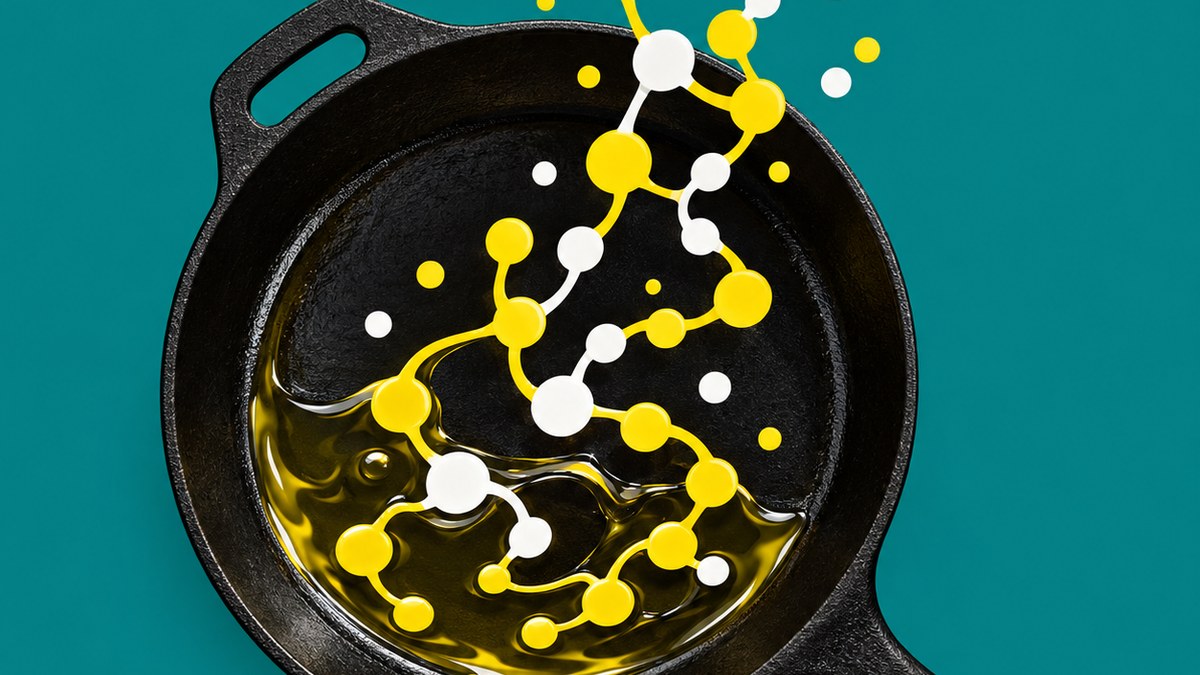
Bare cast iron is a poor cooking surface. It rusts quickly, and food sticks to its microscopically rough surface. Yet a well-kept skillet can release a fried egg almost as easily as a coated nonstick pan. The difference is seasoning, and seasoning is not leftover grease. It’s a thin layer of plastic-like material the cook creates on purpose.
The short answer
Seasoning is cooking oil converted by high heat into a hard, cross-linked polymer that bonds to the iron. That layer fills the metal’s surface texture, repels water and gives food less to grip.
What happens in the oven
When a pan coated in a thin film of oil is heated well above the oil’s smoke point, the fat begins to break down and react. The leading explanation is polymerization: unsaturated fatty acids, the ones with carbon double bonds, react with oxygen and link into long, branching chains (PBS NOVA). NOVA notes there are multiple hypotheses about exactly what happens at the molecular level, but polymerization is the predominant one.
At the same time, some of the oil carbonizes. Food science references describe seasoning as a two-part process of polymerization and carbonization, alongside related reactions such as oxidation and cyclization (Science of Cooking). The result is a matrix of polymerized oil and carbon residue, built layer by thin layer (Cast Iron Collector).
Why double bonds matter
The chemistry explains a practical rule. Oils rich in unsaturated fats have more reactive sites for oxygen and cross-linking, so they form a polymer more readily. Highly saturated fats have fewer of these sites and tend to stay softer. This is why flaxseed, canola, vegetable and similar oils are common seasoning choices, while butter is generally a poor one (the milk solids burn).
Temperature matters as much as oil choice. Guides aimed at home cooks usually point to an oven range of about 400–500°F, high enough to drive the reaction rather than simply leave a sticky film (The Iron Patina).
Why thin layers beat thick ones
A thick coat of oil can’t react evenly. The surface polymerizes while the oil underneath stays liquid, leaving a gummy, blotchy finish that flakes. Thin coats, wiped on and then wiped back off until the pan looks almost dry, cure fully. Several thin cycles build a harder surface than one heavy one.
How to season, based on the chemistry
- Clean and dry thoroughly. Water left in the pores promotes rust. Warming the pan on the stove drives off moisture.
- Apply a very thin coat of an unsaturated oil to every surface, including the handle and underside.
- Wipe off the excess until the pan looks nearly dry.
- Bake upside down at around 450°F for about an hour, then let it cool in the oven.
- Repeat three or four times for a new or stripped pan.
Everyday cooking with fat adds to the layer over time, which is why older pans often perform best.
Common misconception: soap ruins seasoning
A true polymer layer is chemically bonded and isn’t dissolved by a little dish soap. What damages seasoning is soaking, scouring down to bare metal or leaving the pan wet. Wash, dry immediately and wipe on a trace of oil.
The bottom line
Cast iron needs seasoning because iron alone is rough and reactive. Heat transforms a thin film of oil into a durable polymer, turning a rust-prone slab of metal into one of the most dependable pans in the kitchen.
Kitchen Chemistry — Hubert Bonizzone, October 2, 2026
Leave a Reply