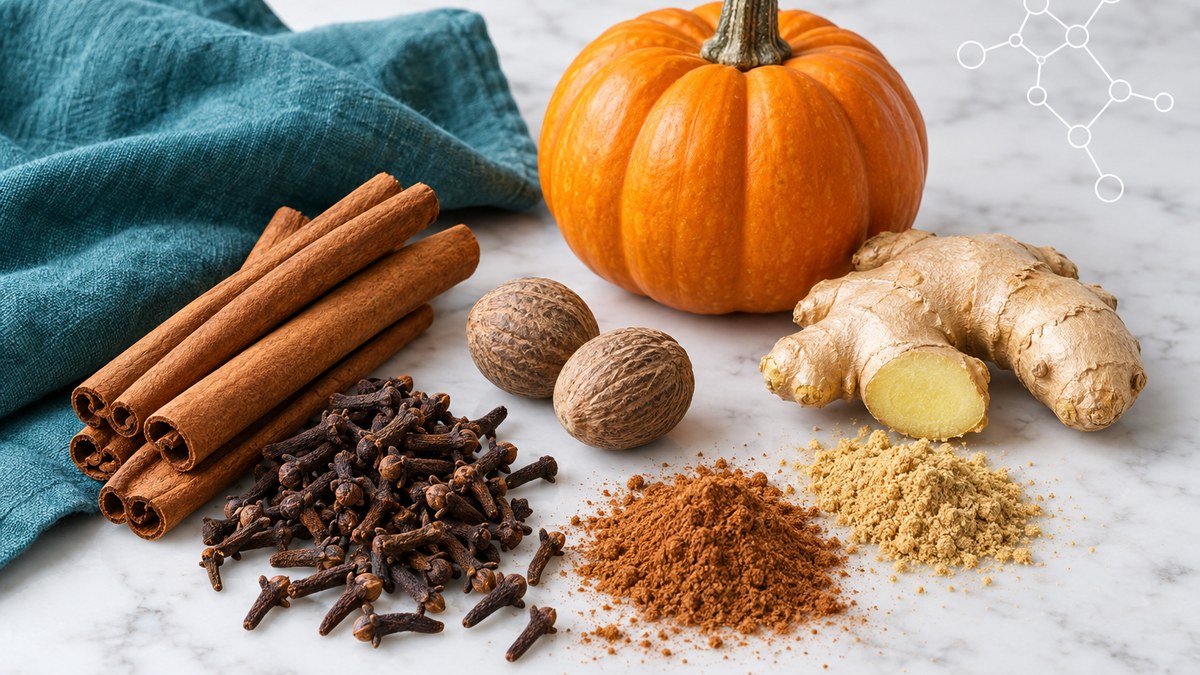
Pumpkin spice isn’t a pumpkin flavor, and it never was. The blend contains no pumpkin at all. It’s built to taste like pumpkin pie, which is a different thing entirely: a sweet custard carried almost entirely by cinnamon, nutmeg, ginger and clove or allspice (Chemical & Engineering News, 2014). Pumpkins do have volatile compounds of their own, but they’re mild and vegetal, nothing like the warm, sweet aroma people mean when they say “pumpkin spice.”
So the real question is not why pumpkin spice tastes like pumpkin. It’s why four tropical spices, none of which grow anywhere near a New England pumpkin patch, have come to smell like October. The answer is part chemistry, part neuroscience, part marketing calendar. Here is the actual science behind each piece.
The chemistry: four spices, hundreds of molecules
Pumpkin spice chemistry starts with volume. Researchers analyzing the blend have identified at least 340 flavor compounds in it, and C&EN notes that the brain can recognize the overall flavor from a small fraction of them, roughly 5 to 10 percent (C&EN, 2014). A handful of molecules do most of the work.
Cinnamon: cinnamaldehyde. The warm, sweet backbone of the blend is cinnamaldehyde, an aromatic aldehyde. It’s also responsible for the faint warming bite of cinnamon. Cinnamaldehyde activates TRPA1, an ion channel on sensory nerves that responds to pungent compounds such as mustard oil and garlic (Bandell et al., Neuron, 2004). That’s why a strong cinnamon candy feels almost hot even though it isn’t.
Clove (or allspice): eugenol. Eugenol is the dominant compound in clove, making up 70 to 90 percent of what is extracted from the buds (PMC7227856). It brings the deep, slightly medicinal warmth that keeps the blend from tasting like a cinnamon roll. Allspice also contains eugenol, which is why recipes treat the two as interchangeable.
Nutmeg: sabinene. Nutmeg contributes sabinene, a terpene with a woody, peppery note (C&EN, 2014).
Ginger: zingiberene. Dried ginger adds zingiberene, another terpene, which gives the blend a bright, slightly citrusy lift.
When chemist Donald Mencer and a group of undergraduates ran grocery-store pumpkin pie spice through gas chromatography-mass spectrometry, they also found pinene, a compound shared by cinnamon, nutmeg, ginger and allspice, with a resinous scent reminiscent of evergreens (C&EN, 2014). The quietly clever thing about the blend is that overlap: the four spices share some aroma molecules, so they read as one coherent smell rather than four competing ones.
What heat adds: the Maillard layer
Raw spice is only half the story. A pumpkin pie or a spiced latte is a heated food, and heat changes the aroma profile.
When sugars and proteins are heated together, they undergo the Maillard reaction, the same family of reactions that browns a steak crust (covered in more depth in our post on the chemistry of a perfect sear). In a pie, the reaction produces caramel-like, toasted and faintly smoky volatile compounds. C&EN points to cyclotene, which smells like maple and caramel, and vanillin as plausible contributors to the finished “pumpkin spice” impression (C&EN, 2014).
That explains why a jar of the blend never quite smells like the pie. The jar holds the spice volatiles. The oven supplies the rest.
There is a practical consequence too. Ground spices have far more surface area than whole ones, so their volatile compounds evaporate and degrade faster through oxidation. A jar of pumpkin pie spice that has sat open since last November has lost a meaningful share of its aroma. If yours smells faint, that’s not your imagination.
In practice: building the blend at home
Knowing which molecule comes from which spice turns a recipe into something you can adjust deliberately.
A common home ratio is 3 parts ground cinnamon, 1 part ground ginger, 1 part ground nutmeg and half a part ground clove or allspice. The proportions follow the chemistry. Cinnamaldehyde is pleasant even in large amounts, so cinnamon carries the volume. Eugenol is potent and turns medicinal quickly, so clove stays small; a heavy hand with it is the most common reason a homemade blend tastes like a dentist’s office rather than a bakery.
If your blend tastes flat, the fix is usually freshness, not quantity. Whole spices hold their volatile compounds inside intact plant cells, and grinding ruptures those cells and starts the clock on evaporation and oxidation. Grating a whole nutmeg straight into the bowl gives a sharper, brighter sabinene note than pre-ground nutmeg can.
Gently warming whole spices in a dry pan for a minute or two before grinding is another option. The heat drives aroma compounds out of the plant tissue and starts some light browning reactions on the surface, so the blend smells more roasted. The trade-off is time: a toasted blend should be used within days, not months.
Finally, remember where the second half of the aroma comes from. A spiced syrup or whipped cream that never gets heated will taste “raw” next to a baked pie, because it has the spice volatiles but none of the Maillard products. Simmering the spices briefly in milk or a sugar syrup closes some of that gap.
The history: a pie spice that became a season
The spices themselves are old. Cookbooks in early America already paired stewed pumpkin with ginger, mace, nutmeg and allspice; a 1796 recipe in American Cookery used exactly that combination (CBS News).
The blend as a single product is much newer. McCormick introduced pumpkin pie spice in 1934, a few years after canned pumpkin first reached shelves, as a convenience for home bakers (CBS News). Even now, according to the company, 80 percent of its pumpkin pie spice sales happen during the holiday season.
The jump from pie to everything else came in 2003, when Starbucks developed its Pumpkin Spice Latte and tested it in 100 stores before rolling it out across the U.S. and Canada the next fall (CBS News). By 2014, C&EN reported that the company had sold more than 200 million of them. In recent years it has returned in late August; in 2026 it came back on August 25, which Starbucks says became the strongest fall launch day across the U.S. and Canada in its history (Starbucks).
A North Carolina State University food scientist traces the spice combination itself back to the 1600s, long before either the jar or the latte (NC State University). The latte didn’t invent the flavor. It made it portable.
The neuroscience: why a smell can mean a season
Chemistry explains what you’re smelling. It doesn’t explain why the smell feels like a specific time of year. For that, you need the brain.
Smell is wired differently from the other senses. Odor signals travel from the nose to the olfactory bulb and then, with very few relay steps, into limbic structures involved in emotion and memory, including the amygdala and hippocampus. One recent review describes the olfactory pathway as having the most direct subcortical connection to the limbic system of any sense, roughly two synapses (PMC12842608).
That wiring shows up in behavior. Memories triggered by odors tend to be more emotional and feel more vivid than memories triggered by the same item shown as a word or a picture. In one functional imaging study, personally meaningful odors produced greater amygdala and hippocampal activation than other cues (Oxford Academic, review chapter on odor-evoked memory). Psychologists call this the Proust phenomenon, after the novelist whose madeleine dipped in tea unlocked a flood of childhood memory, and a review in Chemical Senses found preliminary evidence that odors evoke autobiographical memories more effectively than other cues, likely through the link between memory and affect (Chu & Downes, Chemical Senses, 2000).
Put those two facts together. Cinnamon, clove and nutmeg show up in American kitchens most heavily between October and December: pies, cider, holiday baking. Year after year, the same volatile compounds get paired with the same season, the same cold air, the same gatherings. The smell becomes a cue for the whole experience. None of this makes pumpkin spice magical. It’s associative learning, repeated every autumn for most of a lifetime.
The marketing layer: scarcity as a feature
There’s one more ingredient, and it isn’t chemical. Pumpkin spice is seasonal on purpose.
Because the products appear for a limited window, usually late summer through the holidays, the smell never has a chance to become ordinary. A flavor you could buy year-round would gradually lose its association with any particular season. A flavor that disappears every January and comes back every August keeps the link sharp. Reputation and performance aren’t the same thing, and pumpkin spice benefits from both: the chemistry delivers a genuinely pleasant aroma, and the calendar protects its meaning.
The takeaway
Pumpkin spice smells like fall because four spices share a set of warm, overlapping aroma molecules, because heat adds a caramelized layer on top, and because your olfactory system is wired to file smells with emotion and memory. Seasonal availability does the rest.
If you want the effect at home, buy whole cinnamon, whole cloves and whole nutmeg, grate or grind them close to when you bake, and let the oven finish the job. Consider this your lab notes for your kitchen: fresh volatiles, a little Maillard browning, and a season’s worth of memories doing the heavy lifting.
Hubert Bonizzone, October 6, 2026
Leave a Reply