
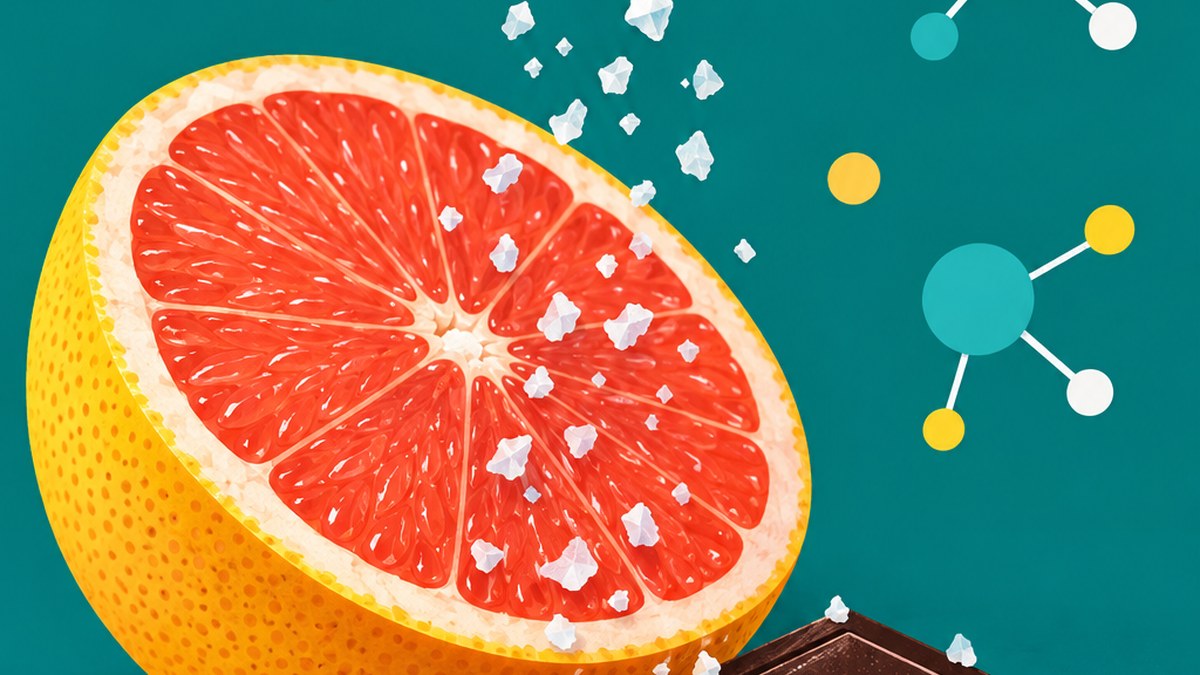
A pinch of salt in brownie batter doesn’t make brownies taste salty. It makes them taste more like chocolate. A little salt on grapefruit makes it taste sweeter. These are not kitchen superstitions. They follow from how the tongue processes competing tastes, and the explanation is more interesting than “salt adds flavor.”
The short answer
Salt does two jobs. It adds its own salty taste, and, more importantly for flavor, it suppresses bitterness. When bitterness drops, sweetness and savory notes that were being masked become more noticeable. The food doesn’t gain flavor so much as lose interference.
The experiment that showed it
In 1997, researchers Paul Breslin and Gary Beauchamp published a short paper in Nature with a telling title: salt enhances flavour by suppressing bitterness (Nature). Their proposal was that salts act as a selective filter. Unpleasant tastes, such as bitterness, are suppressed more strongly than pleasant ones, such as sweetness, which increases the salience of the pleasant tastes.
In other words, sodium doesn’t simply raise every flavor. It changes the balance between them.
How the mechanism works
Taste is not the old “tongue map” of separate zones. Individual taste cells respond to more than one basic taste, and signals are integrated in the brain (BBC Science Focus). Because tastes are processed together, one can mask another.
The Institute of Medicine’s review of sodium in food describes bitterness suppression as one of the best understood ways sodium improves overall flavor (NCBI Bookshelf). Food scientists studying sodium reduction list the same functions: salt increases saltiness, reduces bitterness, and enhances sweetness and other matching flavors (PMC). That’s why cutting salt from a processed food often makes it taste flat or slightly bitter, not merely less salty.
Why it matters in everyday cooking
Once the mechanism is clear, several familiar habits make sense:
- Chocolate and coffee. Both carry natural bitterness. A small amount of salt lets their sweet and roasted notes come through.
- Vegetables. Brassicas like kale, broccoli and Brussels sprouts contain bitter compounds. Salt tempers them.
- Fruit. Grapefruit, melon and tomatoes taste sweeter with a light sprinkle, because the bitter and sour edges are dulled.
- Baking. Most sweet recipes call for a small amount of salt for balance, not saltiness.
What salt does beyond taste
Salt also changes texture. Through osmosis it draws moisture out of vegetables and meat surfaces, and in meat it helps proteins hold water, which is why brining produces juicier results (123 Food Science). Those effects are physical, separate from the tongue, but they add to the sense that salted food is “better.”
Common misconception: more salt means more flavor
The filter effect has a limit. Past a point, saltiness itself becomes the dominant taste and hides everything else. The goal is enough sodium to suppress bitterness, usually well below the point where food tastes salty. Adding salt gradually and tasting between additions is the practical way to find that point.
The bottom line
Salt improves flavor mainly by subtraction. It turns down bitterness so sweetness and savory depth can come forward. That’s why a pinch in a dessert or on fruit works: the food isn’t becoming salty. It’s becoming more clearly itself.
Kitchen Chemistry — Hubert Bonizzone, September 29, 2026
Leave a Reply