
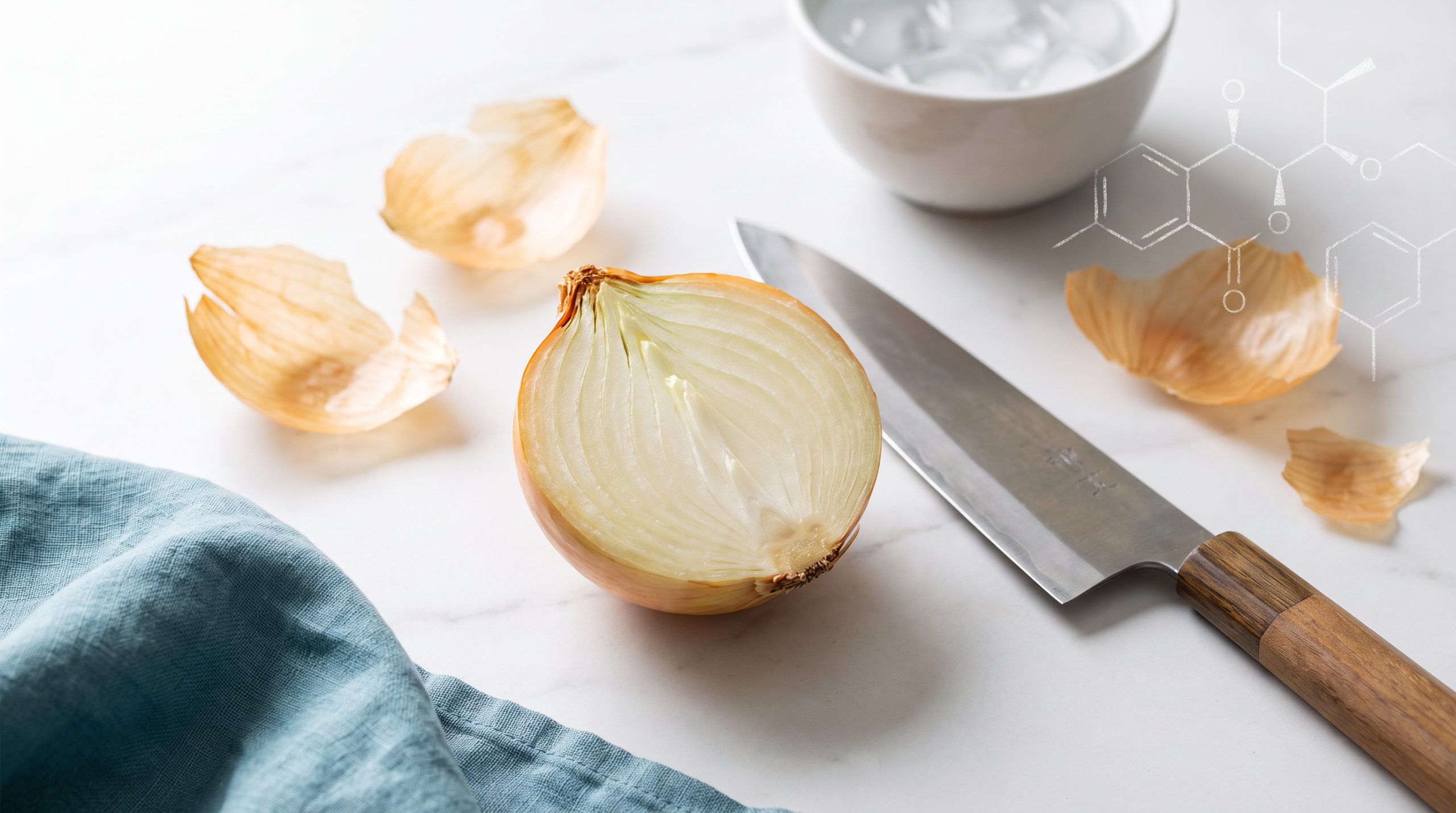
Chilling the onion. Breathing through your mouth. Lighting a candle. Cutting it under running water. Every one of these tips assumes the same thing: that onion tears are a nuisance to be humidified, chilled, or blown away. The chemistry says otherwise. Onion tears are the end product of a small, elegant enzyme cascade that the plant runs on purpose when its cells are damaged, and the compound doing the crying is not a general irritant — it is a specific volatile sulfine, synthesized by a specific enzyme, and released in a specific way when a blade meets tissue. The interesting question is not how to disguise it. It is what actually interrupts it.
The short version: an onion’s tear-triggering compound, ***syn-propanethial S*-oxide**, is made in a two-step reaction the moment cells rupture, and it reaches your face largely inside a fine, high-velocity mist ejected from the cut. Two variables you can control — enzyme activity and mist generation — do most of the work. Most of the folklore controls neither.
The onion is running a chemical defense you helped trigger
Intact onion cells keep two things apart on purpose. One compartment holds amino-acid–derived flavor precursors — the S-alk(en)yl-L-cysteine S-oxides, of which the onion-specific version is isoalliin, also written as trans-(+)-S-(1-propenyl)-L-cysteine S-oxide, sometimes abbreviated PRENCSO (Block, Angewandte Chemie International Edition, 1992). A separate compartment holds the enzyme alliinase (EC 4.4.1.4), a pyridoxal-5′-phosphate–dependent lyase that cleaves those precursors as soon as it can reach them (Block, 1992).
Slicing an onion is, mechanically, the event that mixes the two. Alliinase acts on isoalliin and produces **(E)-1-propenesulfenic acid, an unstable intermediate that in garlic-family chemistry would ordinarily just condense into thiosulfinates — the compounds that carry most of the flavor of freshly cut alliums. In onion, one further step happens instead. A separate enzyme, lachrymatory-factor synthase (LFS), isomerizes 1-propenesulfenic acid into the actual lachrymator, syn-propanethial S-oxide** (Imai et al., Nature, 2002; PubMed record PMID 12384686). The compound reaches the cornea, activates ciliary sensory nerves, and the tear reflex closes the loop (Wu et al., PNAS, 2025).
Two details from the Imai discovery are worth keeping. First, when the authors removed LFS from an in-vitro reaction, they got no tearing compound — thiosulfinate yield went up instead, which is why garlic (which has alliinase but not LFS) will burn your nose without making you cry the same way an onion does (Imai et al., 2002). Second, silencing LFS in transgenic onions produced a tearless bulb whose flavor precursors were largely preserved, because LFS is not doing the flavor work; alliinase is (Silvaroli et al., ACS Chemical Biology, 2017). Onion tears and onion flavor are, biochemically, not the same reaction. That distinction is what makes it possible to have both.
The mechanism at the atomic level, in one paragraph
The 2017 crystal structure of onion LFS resolved how a small, otherwise inconspicuous enzyme performs a single, unusual trick: it rearranges a sulfenic acid’s double bond without changing the molecular formula, locking the sulfur–carbon geometry into the Z configuration that gives the compound its name. In the proposed mechanism, a glutamate residue (Glu88) deprotonates the sulfenic acid substrate; a nearby arginine (Arg71) stabilizes Glu88 by lowering its pKₐ from a computed 8.0 down to 5.6 through hydrogen-bonding and coulombic effects; a transient carbanion forms at the terminal carbon; and a tyrosine (Tyr102) donates a proton back, producing ***syn-propanethial S*-oxide** in the (Z) configuration (Silvaroli et al., 2017). Mutating either Arg71 or Glu88 abolishes activity entirely. This is not molecular trivia. It is the reason the folk fixes that target “the fumes” cannot touch the reaction itself: nothing in your kitchen is capable of walking into an enzyme active site and untying an arginine–glutamate pair.
The structure of the tear compound was itself the product of a slow argument. Its molecular formula was determined in 1956, but its (Z) — that is, syn — geometry was not pinned down until Eric Block and colleagues did it in 1979, and roughly 5% of the natural product turns out to have the (E), or anti, geometry (American Chemical Society, “syn-Propanethial S-oxide”). None of this makes the compound exotic. It is small, volatile, and reactive; when it meets water at the ocular surface, it produces the localized irritation your reflex reads as pain and answers with tears (Royal Society of Chemistry, Propanethial-S-oxide).
The mist is not incidental — it is the delivery vehicle
For decades, the argument for kitchen-hood fans, mouth breathing, and running water assumed the compound floated upward as vapor. In October 2025, a Cornell group led by Sunghwan Jung published a high-speed imaging study in PNAS that changed the resolution on that assumption. Using a small guillotine rig and blades of controlled sharpness, they showed that onion cutting ejects fluid in two distinct stages: first, a high-speed atomization-like outburst as the blade breaches an internal layer and its stored pressure releases, and second, a slower phase in which fluid ligaments fragment into satellite droplets (Wu et al., PNAS, 2025; Cornell Chronicle summary, 2025). Initial droplet velocities range from roughly 5 to 40 m/s, and the outburst fragments into hundreds of satellite droplets within roughly 20 milliseconds of blade contact.
The practical consequence lands in the same paper. When the Cornell group varied blade sharpness and cutting speed, blunter blades produced as much as roughly forty times more droplets than sharp ones, and faster cutting produced about four times more than slow cutting (Washington Times summary of Wu et al. 2025; Cornell Chronicle, 2025). The mechanism is intuitive once it is measured: a blunt blade compresses each layer before it fractures, storing elastic energy in the tissue that then converts into ejection velocity when the layer finally gives. A sharp thin blade shears cells cleanly and lets less pressure accumulate. The tear compound is being made either way — but with a sharp blade, less of it gets airborne, and less of it reaches your face at eye-level velocity.
What people get wrong
Almost every “how not to cry while cutting onions” list gets a few pieces right by accident and a few wrong on principle. The following are worth naming.
Chilling does something, but not what the tips claim. Colder tissue slows enzyme kinetics, which reduces the rate of the alliinase and LFS reactions, so a briefly refrigerated onion can produce less lachrymator per unit time. It does not turn the reaction off; both enzymes work fine at refrigerator temperatures, and cold storage can shift the organosulfur profile of the bulb over longer periods (Tang et al., Food Science & Nutrition, 2026). The bigger reason chilling can help is unrelated to chemistry: cold onion flesh is firmer, so a decent blade shears cleanly, and less juice atomizes.
Cutting under running water works — because it captures the mist, not because it “seals” anything. The tear compound is water-reactive on contact with the eye, and the aerosol droplets that carry it are readily washed out of the air by a stream of water. That is a fluid-mechanics fix (Wu et al., 2025), not an inhibition of the enzyme.
The candle trick has no meaningful evidence. Combustion in a small flame does not remove enough of a low-molecular-weight sulfine at a countertop distance to matter, and no rigorous study supports it. If a candle appears to help, the more likely explanation is that its user cut more carefully because they were paying attention.
Mouth breathing shortens the reflex chain by exactly one nostril. The tear reflex is triggered at the cornea by syn-propanethial S-oxide, not in the nose. Breathing through your mouth may reduce olfactory pungency and the sensation of “sharpness,” but it does not change how much compound reaches your eyes. Sealed goggles do — including cheap swim goggles — because they physically separate the aerosol from the ocular surface.
Reputation and performance are not the same thing. The tricks that survive scrutiny are the ones that either slow the enzymes, remove the mist, or block the compound from the cornea. Everything else is theater.
What actually reduces onion tears in your kitchen
- Use a genuinely sharp, thin blade. This is the single largest lever in the 2025 Cornell data, and it comes with the useful side effect of safer, more precise cuts (Wu et al., 2025).
- Cut slowly. Slower blade speed reduces the pressure spike inside each layer and, with it, the number and velocity of ejected droplets.
- Refrigerate the onion for 15–30 minutes before cutting. The effect is modest but real: enzyme rates slow, and the tissue firms up enough to help the blade.
- Manage the air, not the fumes. A downdraft fan, an open window with a cross-breeze, or cutting near — not into — a stream of running water reduces how much aerosol reaches your face. A candle does not.
- If tears are chronic, wear sealed eyewear. Well-fitted swim or lab goggles are the mechanical solution the reflex was never designed to defeat.
- Consider tearless onion cultivars where available. Sunions and a few related low-lachrymator varieties reach retail seasonally and produce meaningfully less syn-propanethial S-oxide, consistent with reduced LFS-substrate flux described in the transgenic work (Silvaroli et al., 2017).
None of this makes the enzyme cascade less real; it just means you have credible ways to fight it upstream (chill, sharpen, slow down), in the air (ventilation, water stream), or at the eye (goggles).
The Takeaway
An onion is not attacking you; it is running a rehearsed, two-enzyme chemical program the moment its cells are damaged, and most of the tear compound reaches you as a droplet cloud, not as vapor. The interventions that actually work slow the enzymes, capture the mist, or block the cornea — which is why a sharp thin blade, a slow cut, and a chilled onion outperform a lit candle and a mouthful of held breath. That is the whole formula: the actual chemistry behind why cutting onions makes you cry, and the short list of fixes that survive it.
Leave a Reply