
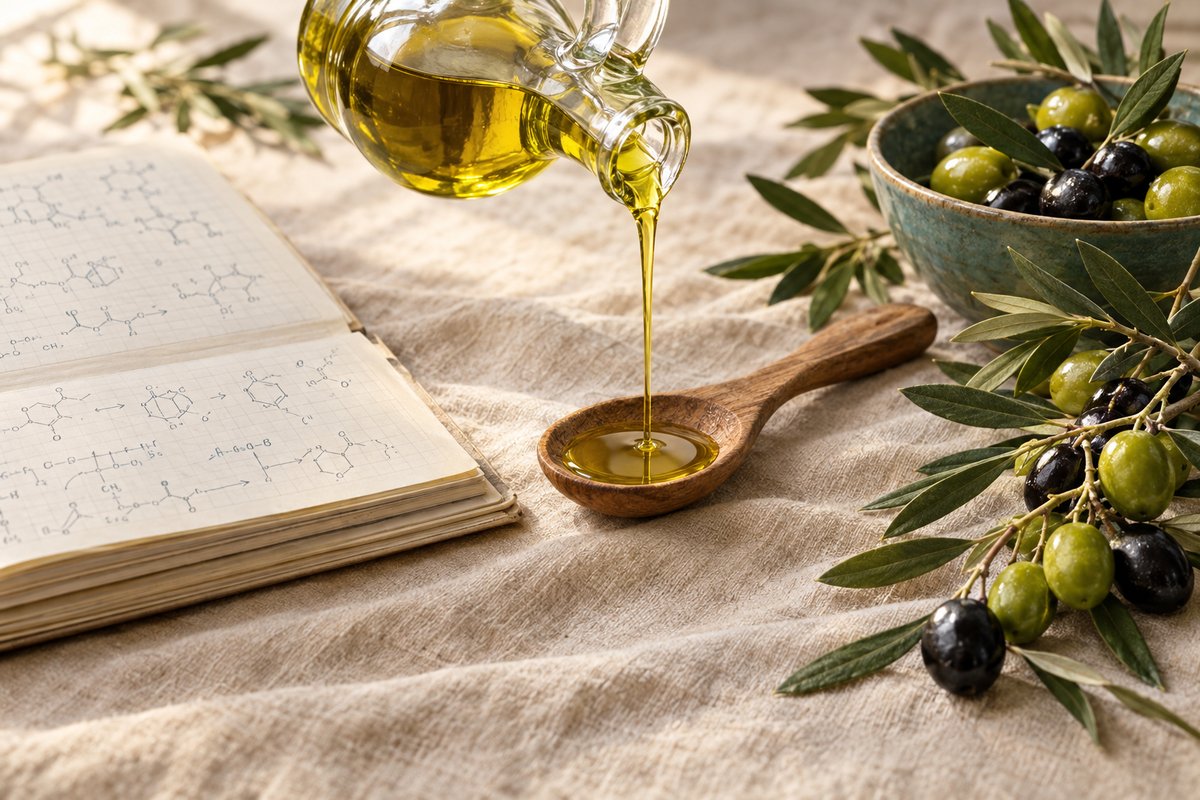
An olive oil may carry a legally permitted health claim only when 20 grams contain at least 5 milligrams of hydroxytyrosol and its derivatives. That number is not marketing poetry; it is the threshold behind the European Union’s statement that olive-oil polyphenols “contribute to the protection of blood lipids from oxidative stress” (EFSA claim evidence, Antioxidants, 2023). It also explains why “extra virgin” matters more than the word suggests: the same careful harvesting and mechanical extraction that preserve an oil’s flavor tend to preserve the reactive minor compounds that make it chemically distinct.
But extra virgin is not a halo that makes every bottle nutritionally identical, nor a reason to treat a skillet as forbidden territory. It is a category with strict sensory and analytical limits, and those limits describe how the oil arrived in the bottle—not an eternal guarantee of what heat, oxygen, light, and time will leave there. The useful question in the oil aisle is therefore not “is EVOO good?” It is: what did this producer preserve, what has this bottle retained, and what am I about to do with it? That is extra virgin olive oil chemistry with a grocery cart attached.
Extra virgin olive oil chemistry: a processing category, not a flavor adjective
Olive oil begins as fruit tissue disrupted by crushing. Intact olive cells keep triglycerides—the molecules built from glycerol and fatty acids—largely separated from enzymes and water; bruised fruit and delayed milling let lipase enzymes start hydrolyzing those triglycerides, releasing free fatty acids. That is why free acidity, expressed as oleic acid, is a useful record of fruit condition and mill handling rather than a measure of whether the oil tastes “acidic” on your tongue (University of California olive-oil chemistry guide).
The International Olive Council’s current trade standard defines extra-virgin olive oil as virgin oil with free acidity no higher than 0.80 grams per 100 grams (0.8%), along with the required chemical and organoleptic characteristics. Its peroxide-value limit is 20 milliequivalents of active oxygen per kilogram—the early oxidation products formed when unsaturated fatty acids react with oxygen (International Olive Council trade standard). In plain kitchen terms: a low free-fatty-acid percentage suggests the olives were sound and handled quickly; a peroxide value tracks one stage of rancidity chemistry; neither number by itself tells you how peppery, fresh, or polyphenol-rich the oil is today. A bottle can qualify at 0.8% yet be less fresh and less phenolic than one at 0.2%; the threshold is a floor, not a flavor score.
There is also a human instrument in the standard. A trained panel must find the median defect equal to zero and fruitiness above zero for an oil to qualify as extra virgin. “Rancid,” “fusty,” and “winey-vinegary” are not romantic tasting notes; they are named defects produced by oxidation, anaerobic fermentation, or poor fruit storage. Color is conspicuously absent as a quality cue. A very green oil can be chlorophyll-rich, a golden one can be excellent, and neither hue can do the work of a sensory panel or a laboratory.
This is the first correction to make at the shelf: extra virgin is a serious minimum standard, not a ranking from good to best. An oil sitting just inside the IOC limit and an early-harvest oil with far lower free acidity can both legally say EVOO. Reputation and performance are not the same thing, which is why a harvest date, a real producer, and third-party verification matter after the front label has made its claim.
The molecules that make fresh oil bitter, peppery, and more useful
Most olive oil is fat, principally oleic acid packaged in triglycerides. The part that makes fresh extra virgin oil interesting is much smaller: a variable fraction of phenolic compounds, pigments, volatile aroma compounds, squalene, and vitamin E. Refining can leave the fatty-acid profile largely intact while stripping much of this minor fraction, which is the chemical reason regular “olive oil”—typically refined olive oil blended with some virgin oil—tastes milder and generally contains fewer phenolics than extra virgin oil (Gorzynik-Debicka et al., International Journal of Molecular Sciences, 2018).
The bitter edge comes largely from secoiridoid compounds derived from oleuropein and ligstroside. Their structures change as olives ripen, are crushed, and meet water during malaxation—the slow mixing step before separation—so cultivar, harvest maturity, temperature, and extraction method all change the finished chemistry. Picual, Coratina, and early-picked oils often read as more bitter and pungent than a mild Arbequina, not because bitterness is a defect, but because the oil carries a different concentration and mix of these compounds (Finicelli et al., Nutrients, 2021).
Two names are worth learning. Hydroxytyrosol is one of olive oil’s best-studied simple phenols and the molecule family explicitly named by the EFSA threshold. Oleocanthal, a dialdehydic phenolic compound, produces the peppery sting at the back of the throat when you taste fresh EVOO. Beauchamp and colleagues showed in 2005 that oleocanthal inhibits cyclooxygenase enzymes in a manner similar to ibuprofen, which is a biochemical observation—not permission to call oil medicine (Beauchamp et al., Nature, 2005).
That throat catch is the fastest at-home clue you have that a robust oil still contains pungent phenolics, but it is not a purity test. A gentle oil may be fresh; an aggressively peppery oil can still be mishandled, old, or mislabelled. The actual chemistry behind an honest bottle is a combination of traceable production, clean sensory assessment, and laboratory measurements, not one dramatic cough over a bread plate.
The EFSA number is real. The health conclusion needs its full context.
The quietly elegant overlap here is that the legal definition and the health conversation meet at processing. Mechanical extraction of sound fruit, carried out quickly and without deodorizing or chemical refining, is the route that retains the phenolic fraction; it is also what makes low-acidity, defect-free extra virgin oil possible. The EFSA-authorized wording is deliberately narrow: “Olive oil polyphenols contribute to the protection of blood lipids from oxidative stress,” for oil providing at least 5 mg of hydroxytyrosol and derivatives per 20 g (Commission Regulation (EU) No 432/2012). It does not say that every EVOO bottle clears that threshold, or that a tablespoon neutralizes the rest of a diet.
The stronger human evidence comes from dietary pattern research. In PREDIMED, 7,447 Spanish adults at elevated cardiovascular risk were randomized to Mediterranean-diet advice supplemented with extra-virgin olive oil, mixed nuts, or a reduced-fat control diet. The republished primary analysis reported about a 30% relative reduction in major cardiovascular events for the Mediterranean diet supplemented with EVOO compared with the control diet (Estruch et al., New England Journal of Medicine, 2015; corrected and republished analysis, 2018). Participants in the EVOO group were supplied with at least 50 g per day—roughly four tablespoons—so this was a substantial dietary substitution inside a Mediterranean pattern, not a study of occasional drizzle.
That qualification is the whole formula. PREDIMED does not isolate oleocanthal, hydroxytyrosol, or olive oil from vegetables, legumes, fish, meals, and the displacement of less favorable fats. A prespecified analysis did report fewer cases of atrial fibrillation in the EVOO-supplemented group, but it too belongs to the trial’s dietary-pattern context (Martínez-González et al., Circulation, 2014). None of this makes an oil bottle a miracle cure; it makes a good oil a plausible, evidence-supported fat to use regularly in a food pattern that is doing several useful things at once.
Smoke point answers one question; heat stability answers another
“Never cook with extra virgin olive oil” is the standard half-truth. Smoke point is the temperature at which enough volatile compounds are produced for visible smoke, and it varies with free-fatty-acid content, refinement, and the particular bottle. Accredited measurements for extra-virgin oils commonly place it around 190–210°C (374–410°F), while published consumer guidance gives broader ranges because quality varies (Thymelia’s accredited-lab comparison). That makes EVOO a reasonable choice for sautéing, roasting, and much ordinary pan cooking; it is not the ideal default for a pan deliberately driven toward a steak-searing 230–270°C.
The more important mechanism is oxidation. Oleic acid has one double bond, so it is less oxidation-prone than the linoleic acid dominant in many seed oils; extra virgin oil also begins with antioxidants that can interrupt radical reactions. But stability is not invincibility. Heat consumes phenolics before the oil necessarily announces the loss with smoke, which means “it did not smoke” is a poor test for whether a pricey, high-phenolic finishing oil has kept its original character.
A 2023 domestic-frying experiment held 17 EVOOs at 180°C (356°F) for 5, 10, 30, 60, and 120 minutes and measured individual phenolics by liquid chromatography. The oil was heated alone in a stainless-steel pan, so it is a deliberately severe model rather than a direct simulation of a food-filled skillet; after two hours, its mean total-phenolic reduction was 94%, with the rate and starting concentration varying by cultivar and harvest year (Sánchez et al., Journal of Agricultural and Food Chemistry, 2023). That is not an argument against a ten-minute sauté; it is an argument against paying for a vivid, robust EVOO and treating it like an endlessly reusable deep-frying medium.
The practical split is simple. Use an extra virgin oil you enjoy for low- to medium-heat cooking and for dishes where its flavor belongs on the plate. For very high-heat searing or prolonged frying, choose a refined high-smoke-point oil if neutral flavor and temperature headroom are the job; save the expressive EVOO for a finish afterward. The oil’s chemistry is, structurally, an argument for matching the fat to the thermal work.
Why label fraud matters even when you do not care about tasting notes
The category’s complexity has an uncomfortable consequence: most shoppers cannot verify it unaided. UC Davis Olive Center researchers tested imported and California oils bought from California retailers in 2010 and found that 69% of sampled imported oils and 10% of California oils failed to meet IOC/USDA extra-virgin standards, often because of sensory defects or chemical indicators inconsistent with the grade (UC Davis Olive Center’s 2010 report). It was a time-bound retail survey, not proof that every imported bottle is suspect now. It remains useful because it shows why the word “extra virgin” must be backed by more than a familiar label.
Third-party programs provide a more concrete signal. The California Olive Oil Council requires both chemical analysis and a sensory evaluation for its seal; its standards also require harvest traceability, and it lists specific certified oils by producer and year (COOC certification process). For example, the Council’s 2026 archive identifies Cobram Estate Mission as a certified oil (COOC certified-oils listing). That is not an endorsement of one bottle over every other good oil. It is a usable example of what verification looks like: a named producer, a named oil, a harvest-specific certification path, and standards beyond a front-label adjective.
Harvest information is equally practical. California Olive Ranch prints harvest and use-by dates and offers a QR-linked record with harvest season, origin, and bottle-specific testing information for its EVOO line (California Olive Ranch standards). The point is not that every good producer must use a QR code. The point is that “best by” is a weak proxy for an oil whose phenolics, volatile aromas, and oxidation state have been changing since milling; a harvest date gives you a clock you can actually interpret.
What to do in the oil aisle
A useful bottle decision can be made without pretending your kitchen is a chromatography lab. First, look for a harvest date and buy the newest plausible bottle, preferably in dark glass or a tin that has not spent months under bright retail lighting. Second, give extra weight to a producer that makes the lot traceable or to a credible program such as the COOC seal; its current limits are tighter than the IOC floor, including free acidity at or below 0.5% and peroxide value at or below 15 meq O₂/kg. A country name alone is not the same thing as verification. Third, buy for the job: a robust, green, bitter-pungent EVOO earns its premium raw, on beans, soups, vegetables, and bread, while a neutral refined oil can make more sense for a hard sear.
When you open it, use your senses honestly. Fruitiness can read as cut grass, green tomato, almond, or artichoke; bitterness on the tongue and a peppery throat sensation are positive attributes in a fresh robust oil. Stale nuts, crayons, cardboard, or putty are not sophistication. Seal the bottle, keep it cool and dark, and use it instead of treating it as kitchen decor—oxygen has been working since the first pour.
The Takeaway
- 1. “Extra virgin” matters because it describes fruit handling, mechanical extraction, sensory quality, and measurable oxidation limits—not because it is a universal badge of superiority.
- 2. The bitter and peppery compounds—especially hydroxytyrosol derivatives, oleuropein-derived secoiridoids, and oleocanthal—are why a fresh, well-made EVOO tastes alive and may meet the EFSA polyphenol threshold.
- 3. Cook with EVOO when its flavor and temperature range fit the task, but preserve a good robust bottle for finishing rather than burning through its chemistry in prolonged high heat.
The best extra virgin olive oil is not the darkest green one, the most expensive one, or the one with the most elaborate Mediterranean font. It is a recent, traceable bottle that tastes fresh, suits the heat you plan to use, and gives you an actual reason to choose it over ordinary refined oil. That is less mystical than the aisle makes it seem, and considerably more useful.
Leave a Reply