
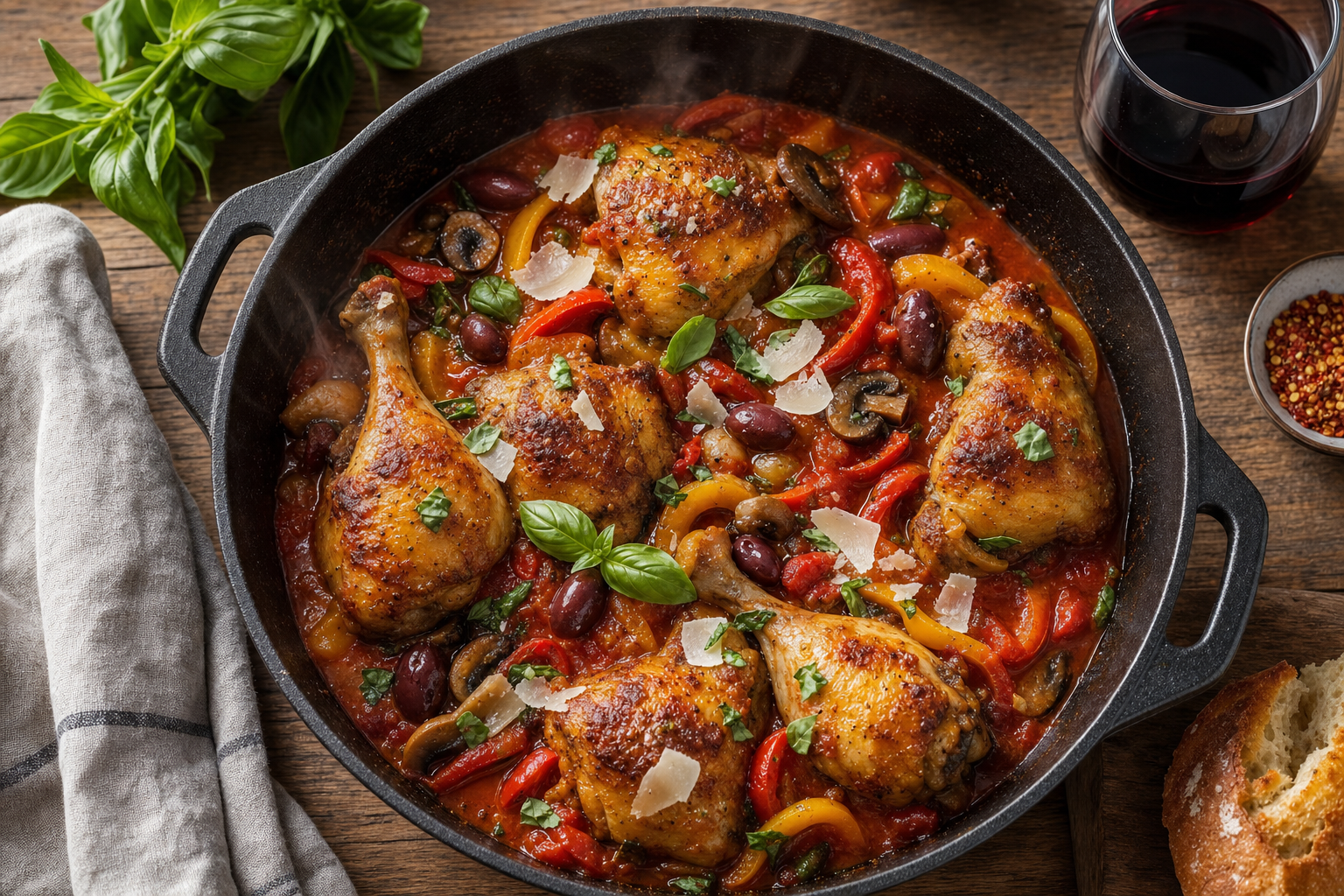
by Hubert Bonizzone
Cacciatore means “hunter” in Italian, and the dish earns the name honestly: it’s what resourceful hunters cooked when the pot needed to stretch whatever was on hand — foraged herbs, wild game, and whatever vegetables were in season — into something that would hold up over slow heat. Recipes for it trace back to Renaissance Italy, and versions still vary by region: Tuscan cacciatore leans on basil and other herbs, while cacciatore from the Veneto tends to go lighter, built on white wine instead of tomato (Global Food Origin). When Italian immigrants brought the dish to the United States, it picked up more tomato and pepper, closer to the version most people know today (Global Food Origin).
What hasn’t changed in 500 years is the basic logic of the dish: brown the meat hard, build a sauce in the same pot, then let everything simmer until the chicken is falling-apart tender and the sauce has thickened into something you want to eat with bread. Here’s how to do that well, and why each step actually works.
Ingredients
For the chicken:
- 3–4 lbs bone-in, skin-on chicken thighs and drumsticks (bone-in holds up better through a long braise than boneless breast)
- Salt and freshly ground black pepper
- 2–3 tablespoons olive oil
For the sauce:
- 1 yellow onion, diced
- 2 bell peppers (red and yellow for sweetness), sliced
- 8 oz cremini mushrooms, sliced
- 4 garlic cloves, minced
- 3/4 cup dry white wine (or substitute chicken stock)
- 1 (28 oz) can whole peeled tomatoes, crushed by hand, or crushed tomatoes
- 1 cup chicken stock
- 2 tablespoons tomato paste
- 1 teaspoon dried oregano
- 1/2 teaspoon red pepper flakes (optional)
- 2 bay leaves
- 1/4 cup fresh basil, torn, plus more for serving
- 2 tablespoons capers or sliced Kalamata olives (optional, for brininess)
- Grated Parmesan, for serving
Instructions
1. Dry and season the chicken.
Pat the chicken completely dry with paper towels, then season generously with salt and pepper. Dry skin browns; wet skin steams. This single step does more for the final flavor than almost anything else in the recipe.
2. Sear hard, don’t rush it.
Heat the olive oil in a large Dutch oven or heavy skillet over medium-high heat until shimmering. Add the chicken skin-side down and don’t touch it for 5–7 minutes, until deeply golden-brown, then flip and brown the other side for another 4–5 minutes. Work in batches if needed — crowding the pan traps steam and prevents browning. Transfer the chicken to a plate.
Why this matters: that browning is the Maillard reaction — a chemical reaction between amino acids and sugars on the meat’s surface that only kicks in around 280–330°F, producing the hundreds of new flavor and aroma compounds responsible for a seared crust’s savory depth (Wikipedia; Maillard, 1912; Maillard Reaction: Mechanism and Influencing Parameters, 2024). Skip the sear and you skip most of the dish’s flavor.
3. Build the sauce in the same pot.
Pour off all but about 2 tablespoons of fat. Add the onion and bell peppers and cook over medium heat for 5–6 minutes until softened. Add the mushrooms and cook another 5 minutes until they release their liquid and start to brown. Add the garlic and cook 30 seconds more, just until fragrant.
4. Deglaze.
Pour in the wine, scraping the bottom of the pot with a wooden spoon to lift up all the browned bits (the “fond”) stuck there — that’s concentrated flavor from the sear, and it’s the whole reason to build the sauce in the same pan. Let the wine simmer for 2–3 minutes to cook off the raw alcohol edge.
5. Add the tomatoes and simmer.
Stir in the crushed tomatoes, chicken stock, tomato paste, oregano, red pepper flakes, and bay leaves. Return the chicken to the pot, skin-side up, nestling it into the sauce without fully submerging it (keeping the skin above the liquid helps it stay less soggy). Bring to a simmer, then reduce heat to low, cover partially, and cook for 35–45 minutes, until the chicken is fork-tender and reaches an internal temperature of 165°F.
Why this matters: the long simmer with tomatoes isn’t just about tenderizing the chicken — cooking tomatoes measurably increases the bioavailability of lycopene, the antioxidant carotenoid responsible for their red color, by breaking down plant cell walls and converting it into a form the body absorbs more easily; adding a fat source (like the olive oil here) further boosts absorption, since lycopene is fat-soluble (Absorption of lycopene from raw and processed tomato, British Journal of Nutrition; Influence of cooking procedure on carotenoid bioavailability, 2013). Cacciatore’s low, slow tomato braise is, structurally, doing the same thing to your vegetables that a sear does to your meat: unlocking flavor and nutrition that raw ingredients simply don’t give up.
6. Finish and serve.
Discard the bay leaves. Stir in the fresh basil and capers or olives if using. Taste and adjust salt and pepper. Serve over polenta, pasta, or crusty bread to catch the sauce, topped with more basil and grated Parmesan.
Notes and Substitutions
- Boneless option: Boneless, skinless thighs work in a pinch — reduce the simmer time to 20–25 minutes to avoid drying them out, since there’s no skin or bone to protect the meat during a longer braise.
- No wine: Swap in an equal amount of chicken stock plus a teaspoon of red wine vinegar for acidity.
- Make it ahead: Cacciatore is a better dish on day two — the sauce continues to develop as it sits. Refrigerate up to 4 days or freeze up to 3 months.
- Regional swap: For a lighter, Veneto-style version, skip the tomatoes entirely and build the sauce from white wine and stock alone, finished with a bit of butter.
The Takeaway
Chicken cacciatore has survived five centuries of retelling because the technique underneath it is genuinely sound: hard sear for the Maillard reaction, a fond-scraping deglaze to keep that flavor in the pot, and a slow tomato braise that tenderizes the meat while making the sauce’s own antioxidants more available to your body. It’s a dish where the folk wisdom and the food science arrive at the same answer — which, around here, is usually where the best recipes live.
Leave a Reply